Hi Folks
It’s been a busy time. We’ve been prepping fields, collecting acorns (and WALNUTS! – more on this soon), and generally trying to navigate the day-to-day at the farm. At the same time, we are also attempting to move the needle on big-picture issues that affect the long-term trajectory of this industry, which is suffering from a very uncertain future. The future is uncertain because society is floundering under chaotic leadership that has failed to articulate any kind of sensible goals or plans. What are the true functions of natural and wild landscapes for society? How are we going to manage them? These broad and fundamental questions have not been answered, and there is no rational discussion leading toward solutions. There are clear paths before us that lead to obviously better circumstances. We just aren’t on them yet.
Let’s change that, shall we?
There are so many fronts to fret about – chemical contamination in people and environments, climate change, education, poor land management practices, the economy. How do we do anything when we have so many problems at once? The good news is that at the core of all of these problems is a simple question that can be answered with simple math. Can the current course of things be sustained for the benefit of most people? If the answer is yes, then No Problem! If the answer is no, then a course correction is required, and simple math can often help set us on that path.
Our interactions with wildland fuels and fire provide a good example, and to the question “is our current approach sustainable and good for people?” the answer is an emphatic no. For the last 100 years, our government has been at war with fire, and we use words of war when describing our relationship with fire. We fight fire. We battle fire. We dig in, entrench and try to contain fire within perimeters. We have strike teams, hotshot crews, smokejumpers and other elite forces, as well as bulldozers, air tankers, helicopters, and other fire-fighting resources on the ground and in the air that are directed by a command structure based on a military model. Ground support, tactical support, government contractors, and the entire fire-fighting establishment and its associated bureaucracy mobilize in battling wildfire all over the west, at a cost of billions of dollars, every single year. Like our military, the fire-fighting complex is bloated and fraught with waste and inefficiency, but when called to the task, it moves in and gets the job of tamping out controllable fires done. Emphasis on controllable. The uncontrollable fires are, well, uncontrollable, at least by any reasonable human force.
There is a fundamental difference between the firefighting industrial complex and the military, however, which is that the “war on fire” is completely lacking in any kind of large-scale strategy. There is a reason for this, and it’s not a good one. Any consideration of the big picture with regard to the war on fire immediately runs into an impregnable wall. Carved into that wall is an enormous sign that says “THIS ISN’T GOING TO WORK.” The defenders of the firefighting industrial complex quietly avoid this obvious truth, and distract our attention with cute bear imagery and press releases about firefighters battling fires and bravely saving people and houses. Smokey the Bear and the USFS actively stoke fears of wildfire in the public and focus on the heroism of firefighters, thereby avoiding responsibility for the unmitigated and devolving disaster that is the war on fire.
If we were fighting a sensible war, we would size up the enemy (unmanaged fuels) and then look at our strategy in relation. There are 600 million acres of inflammable fuels in the conterminous western US alone, most of it spread across rugged, inaccessible terrain. Our approach has been to run around this enormous patch of mountains, canyons and crispy, dry tinder trying to snuff out nearly every fire that pops up. It’s an endless, futile, and extravagantly expensive game of whack-a-mole. And when conditions are right this stuff burns with a terrifying vengeance and there is nothing we can do to stop it. At all. Conditions were ripe across most of western Oregon from July through September this year, and if we had had a single major east wind event, we might have seen some devastating fires. We got lucky this year, but we have more huge fire outbreaks a la 2020 in our future. This we know.
It’s amazing how quickly people forget what fires can do and how powerless we are to stop them when we have done nothing to manage fuels. We appear to be blind to the obvious fact that we can’t stop extreme, wind-driven fires in heavy fuels. We can’t stop them with dozers, air tankers, firebreaks, and all the fire crews in the world. All we can do is stand back and watch them burn. I spent ten seasons working in wildland fire and prescribed fire from 1986 to 1995. In my entire fire career, the only wildland fires we were able to put out were the ones doing the most good – the creeping ground-fires and low intensity burns that clear out the fine fuels and underbrush, thin the forests and keep the forest healthy. These are the fires Smokey has been putting out across the West in a big way since 1930. In Oregon, the resulting forest landscape is an enormous tinderbox, interrupted only by devastating scars of recent, severe, stand-destroying fires that have wiped out millions of acres of forest. In some cases, these fires have been so extreme that, in combination with climate change, the former forest is not only gone, it’s been replaced with chaparral and therefore on a completely different successional trajectory. The newly evolving landscape in these areas, including nearly a million acres of former conifer forest in the Klamath region, will not be a forest anything like the one that burned.
Our approach to fuels and fire has to change it and needs to change on a huge scale. Change is going to involve incentivizing fuels management, including grazing and the extensive implementation of prescribed broadcast burning. There are no better ways to bring excess fuel loadings under control than with fire, and the logic of this is very simple. When fuels in a given landscape are well-managed, periodic prescribed fire is sustainable, inexpensive and effective. In light fuel models, e.g. prairie, savanna or open oak-pine woodlands where ladder fuels have been managed, the landscape becomes essentially immune to fire as soon as it is burned, and fire risk is suppressed for extended periods. I burned our experimental prairie this year in October. Conditions were sub-optimal, but I managed to get most of it to go. Here is what that looked like:
Once burned, it simply can’t burn again. The cost of this burn? Five bucks worth of diesel and gas, two hours of my time and a few bucks in electricity to pump the water for my perimeter wet line. That’s it. Since I’m happy to drag a drip torch around for nothing, the cost of this burn was $2 an acre. And now I have five acres of zero fire risk, benefitting our farm and my neighbors’ properties. What a deal!
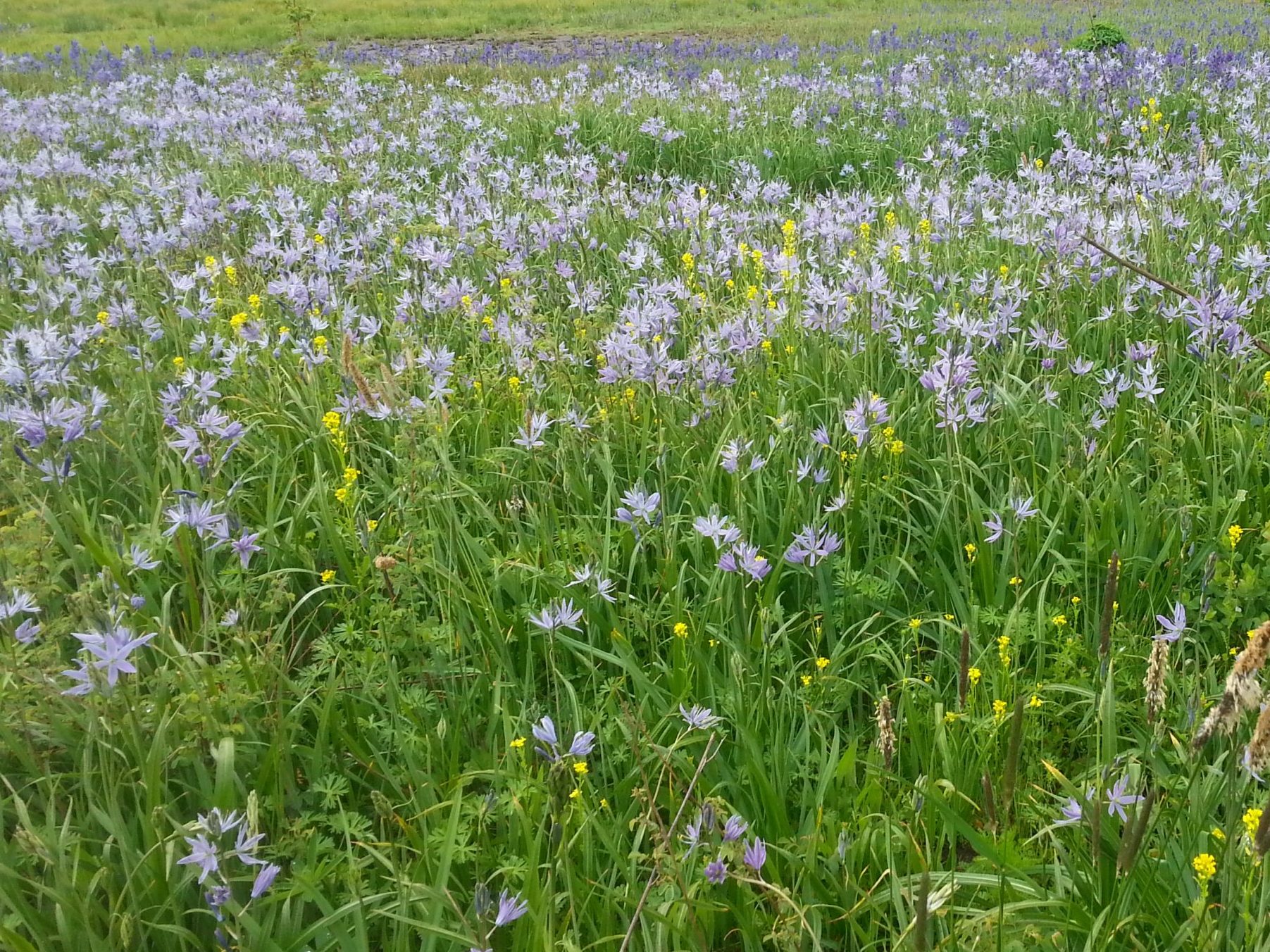
Now we can go on and manage the vegetation, as I did at another prairie site (above) in 2010. If you want to manage for prairies like these, we have all manner of plants in inventory right now. Here are the bare-root herbaceous plants we still have for sale this winter:

And here is the current special on prairie lily bulbs, which runs through December. Buy some bare-roots and bulbs and grow a prairie. Prairies are among our easiest fuels models to manage. Then GET PROFESSIONAL HELP and burn it with guidance and appropriate resources. That’s what keeps the flowers blooming, and the fires from getting out of control.