
Of all of the eight common species of willow in the Willamette Valley, Salix prolixa – MacKenzie willow – is perhaps the least common, the most “climate-adapted” and also the most overlooked. Even most restoration practitioners don’t know it exists as an option. So I’m here to tell you more about it.
MacKenzie willow, as it is understood, is widely distributed throughout the northern Intermountain West, from interior southern California, Nevada, Utah and Colorado, north through the Columbia Basin and well into Canada. It pops over the Cascades and into the Puget Trough and the Willamette Valley, where it shows up along streams, ditches, sloughs and shallow wetlands.
Morphologically, MacKenzie willow is very distinctive, at least as it exists in the Willamette Valley. Here, it forms a very robust arborescent shrub or small tree, with tall, straight, stout stems. Sometimes single-stemmed, each plant more often supports multiple stems and like all of our willows, it coppices prolifically. The lower bark is smooth and bright gray or gray-green, grading to a rich burgundy-brown or chocolate. Twigs are frequently highly glaucous, more or less glabrescent, or sometimes persistently clothed with an appressed, cobwebby, almost scurfy pubescence. Winter buds are very long, smooth to variously appressed-hairy, and strikingly deep reddish-brown to nearly black. Fertile buds frequently sport a distinctive acuminate “tail” that often recurves from the stem. Leaves are typically smooth on both surfaces (other than the sometimes strigose or cobwebby mid-vein), 10-15 cm long, cordate-based, lanceolate and tapering to a long-acuminate tip. If we have a hard frost in October, the leaves of MacKenzie willow can color brilliantly to gold, orange and crimson – far more colorful than any of our other willows.
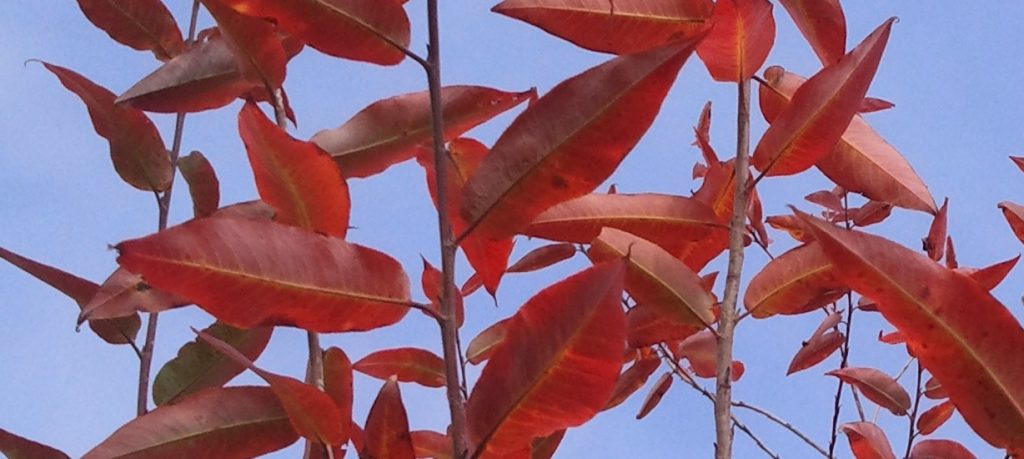
MacKenzie willow seems to span a greater hydrologic range than most Willamette Valley willows, other than Scouler willow. While MacKenzie willow tolerates water as well as Sitka and better than Scouler, it is also distinctly drought-tolerant, making it an excellent choice for drained wetlands and floodplains of incised, beaver-deficient streams. It is highly palatable to beaver, and promotes the restoration of streams and wetlands via the “willow-beaver interaction.” Once hydrology and water tables are restored, more hydrophilic willows and other plants can then thrive.
And yes, provenance matters. We had the opportunity to grow some Columbia basin Salix prolixa material from cuttings, and had it side-by-side with our local accession. The east-side material got absolutely HAMMERED with fungi. It was stunted and ugly. Our local material, on the other hand, was stunning, robust and largely fungus-free.
Our Scholls Valley accession of pure Willamette Valley MacKenzie willow continues to be robust to both our increasingly droughty summers and our still-soggy, moldy, leaf-rotting springs and falls. Some things don’t change, and our prolonged bouts of sloppy weather would appear (ahem..) to be one of those things. We still have over 5000 MacKenzie willow seedlings to sell. ‘Tis the season to feed the beaver, so buy some and help out the beavers, ducks and all their wetland pals!
Could use a break in the rain. We have surpassed 12 inches so far this month, and the parade of soggy storms continues through the extended.
’til next time
-George