
Hi Folks
I’ve had a number of people comment to me directly about the new blog. Almost all of the comments have been very positive, but some folks have asked why the focus on the big negatives? That’s not going to sell plants..
Well, maybe not. I think all of us need to keep an eye trained beyond immediate financial gain. What is immediately profitable isn’t always in our best long-term interest. That’s the point here. All of the messes we find ourselves in – climate change, PFAS contamination, invasive species, on and on – every single one of these has roots in short-term gains for a few with later price tags for many, revealed years later. Where are the folks who made cash at the outset? They are long gone. Who is left holding the bag? Well…that would be us.
I’m tired of cleaning up other people’s messes.
So..back to plants. I firmly believe that plants are essential to making things better. Scholls Valley has worked diligently for over a quarter century to make sure that the plants we sell don’t have hidden price tags, so you can buy them and put them to good use with a clear conscience. Are we going to save the world by planting native plants? Absolutely not, not at this puny scale, anyway. What we are doing right now is minuscule relative to the challenges we face. If those of us in this industry aren’t crystal clear on this, then we are misleading people and greenwashing for the people that are creating the problems. I’m not going to participate, and that is why I am poking at these issues.
I’ve had folks point to the ~20,000 acres secured for local parks and greenspaces since 1995 as evidence that government programs are working to protect ecological processes. That certainly sounds like a lot, but let’s put that figure in context. The Metro UGB is more than 12 times that size – over 250,000 acres – and that urban footprint is not materially different than any other modern American city. It’s polluted, the water flowing out of it is fouled with all manner of toxins, and it is contributing CO2 to the atmosphere just like everyplace else.
Most of the new acreage in these public natural areas is outside the Metro boundary, in areas that would otherwise still be farms and forests, so the actual gain represented by these acquisitions is comparatively small and exceedingly difficult to measure. And these acquisitions have been expensive, both economically to the Metro taxpayer and politically to the already fractious relationship between Portland and its rural neighbors.
Zooming out further, we can see that most natural forests of western Oregon in private ownership have recently been cut over, sprayed and planted with genetically selected Douglas-fir. This massive conversion – six million acres of new Douglas-fir monocultures in the past 30 years – has taken a vastly larger swath of land in exactly the opposite direction that local parks managers are going with their 20,000 acres. These new monocultures include over 200,000 acres in Washington and Clackamas counties – Portland’s back yard. So what land management ethic is prevailing here?
It is ironic that the liquidation of six million acres of western Oregon forests and the acquisition of 20,000 acres around Metro for parks have occurred in the exact same three decades. For every acre purchased by Metro, 300 acres of natural forest were leveled and sterilized. In this context, it is very difficult to see that Metro’s well-intentioned effort at natural area preservation has done much of consequence other than distracting people from the big picture, taking money from efforts that might make a bigger difference and providing a questionable hope that someone, anyone, is taking care of the natural world. I count myself as someone who has contributed to Metro’s natural areas work. I am questioning much of that effort.
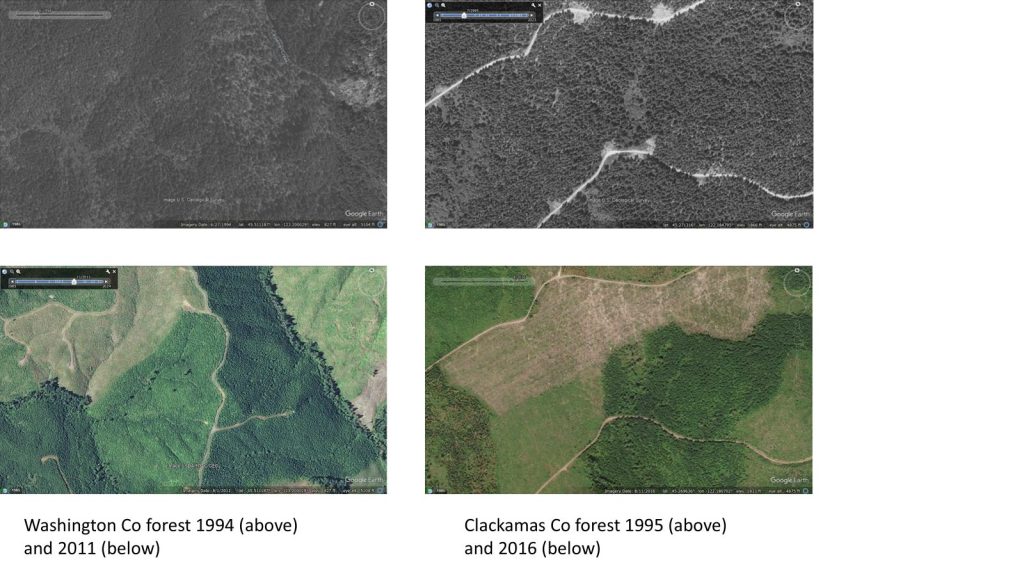
What if, for instance, we directed some of the money spent on Metro’s acquisitions, and the forever costs of maintaining them, toward paying landowners for longer forest rotations? Maybe less of our local forests would look like this. Maybe our local forest economy would be making better wood and employing more people today. Maybe we would have better water, more fish and happier people that are more agreeable with their neighbors. Is any of this possible?
Yes, it is possible, if we start with the question…”what if?”
And then bother to do the math.
Next week is all happy stories about plants. I promise.
-George