
Scholls Valley has been developing and producing climate-adapted plant materials for nearly a quarter century. We have focused our efforts on species that have demonstrated resilience to our increasingly hot, dry summers. The summer of 2025 was the fifth-hottest in the ~100-year climate record for the Tualatin Valley, and was also among the driest. The combination of increased heat and decreased precip has put enormous stress on our local forests and woodlands, and this stress is manifesting in serious declines in some species. For reference, here is the temperature trend:
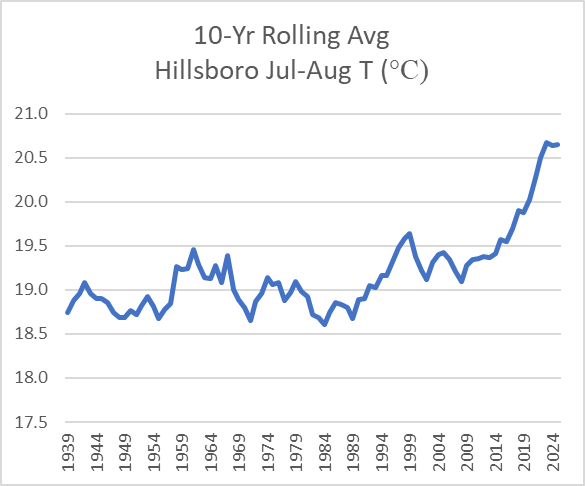
This same general trend is evident in summer climate data for every station in the Willamette Valley – Salem, Estacada, Eugene, McMinnville, etc – they all look like this. So we should not be surprised that the flora is responding, and many species are doing less well. But a few are doing just fine so far.
Among the species that appear robust to the new order is Garry oak. This coming winter, we expect to lift and process, here at Scholls Valley, over 30,000 seedlings of this spectacularly important tree which we have been producing since 2001.
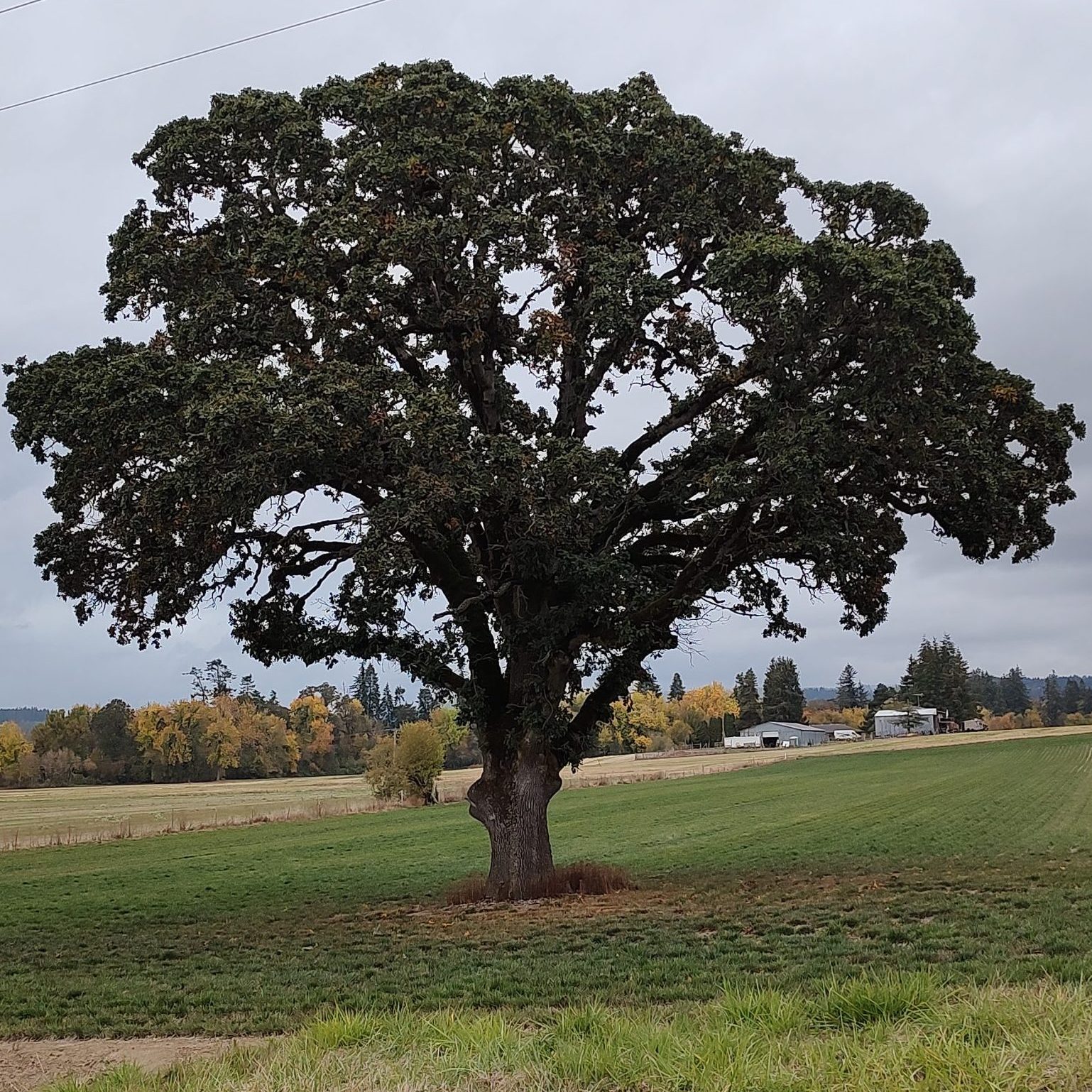
Considered by many as the most valuable wildlife-supporting tree west of the Cascades, Garry oak dominates woodlands, flatwoods and savanna-prairie complexes throughout the interior valleys and foothills of western Oregon and Washington. In flatwoods habitats, Garry oak, Oregon ash and ponderosa pine form a triad, with the two hardwoods acquiring tall forest forms with long trunks and high canopies as they compete for light and space. In open woodlands and savanna, Garry oak takes on its iconic spreading crown. In these open habitats, the crown spread of older individual Garry oak can span 60-80 feet or more, with stout branches extending out from a short, massive trunk.
Mast production in Garry oak, as is true with many other oaks, is cyclical, with heavy acorn production years followed by one to several years with little or no mast. This local to regional coordination of flowering and fruit production is a remarkable phenomenon and it is far from fully understood. An enormous number of genes are potentially involved in mast synchrony, including genes that regulate timing of flowering, resource allocation, flower and fruit abortion, and a host of physiological climatic responses. The fact that trees scattered over large regions with no known direct means to communicate nevertheless manage to coordinate their efforts to enhance reproductive success has been the subject of many hypotheses and studies. Still, the mechanisms and drivers of this miraculously cooperative exercise remain mysterious despite decades of research.
The regional nature of mast synchrony and the likely polygenic control of its expression suggest that this feature of oaks may be sensitive to climate change and also vulnerable to contamination and perturbation by large-scale seed movement. This is just another example of the difficult choices land managers face when deciding how to respond to climate change. Seed movement seems like an obvious response to climate change, but moving individuals from one region to another abandons local adaptation that is unrelated or secondary to climate, including mast-production synchrony (see https://schollsvalley.com/notes-from-the-farm-15-august-2025-plant-migration-isnt-just-about-seed-dispersal/ ).
In the geologic past, forests have adapted to abrupt cataclysmic changes without any assistance from humans. Forest species are inherently adaptable and agile through characteristics of their population structure and ability to exchange genes over long distances. It remains highly speculative that we can intervene in this process at all in a way that promotes healthy forests in the long-term. One thing that humans have demonstrated very clearly is our ability to screw things up by leaping to conclusions. Let’s try to avoid that here. Mass seed movement is the obvious response to forest declines, but let’s think about this carefully before we do too much of it, especially with species like Garry oak that are already here. We can screw up and contaminate existing natural populations that exhibit this kind of delicate, local fine-tuning. Again, the most prudent approach is recruiting progeny of robust local individuals (i.e. collecting seed from healthy trees locally) and promoting more natural recruitment, and then allowing natural selection to winnow out the next forest from as large a number of recruits as we can sustain. Natural selection operating on standing diversity is the golden opportunity in front of us, and we can do it right now, with resources Scholls is producing today. Let’s get these 30,000 oaks planted and then let nature do the rest.
A secondary action, if there is good evidence that local diversity isn’t sufficient to generate the next forest, is to look elsewhere for genotypes to add into the mix. My research and the research of others suggests that introducing haploid genomes – pollen – may be the more effective and efficient means to introduce more diversity while maintaining a local component in the first generation of individuals. This makes sense when you look at the processes involved, and is more in line with the way genes get around. So let’s discuss how to do this. It’s not going to be easy at a large scale, but it is doable. Let’s also look carefully at what we have and see if it’s even necessary at this point to augment local diversity.
The last resort should be large-scale seed movement activities, and again, this is especially true for species that are already here. We are actually less likely to do harm by assisting species migration beyond their native ranges. In these cases, there is no natural population to screw up. For some folks, this has been the most controversial activity related to assisted migration, but it may be the least potentially harmful. I am unaware of any member of the native California flora, for instance, that has invaded here and become a major problem, but there are several species that show promise in filling niches vacated by our heat-intolerant species.
We can look at opportunities to augment our flora with proximate natives in the next few posts. In the meantime, BUY SOME OAKS AND PLANT ‘EM. We have about 10,000 left to sell.