
Of all our current native Willamette Valley trees, Garry oak (Quercus garryana) is your best bet to thrive in today’s hotter, drier summers. Here is a comparison of tree conditions of eight important Willamette Valley tree species:
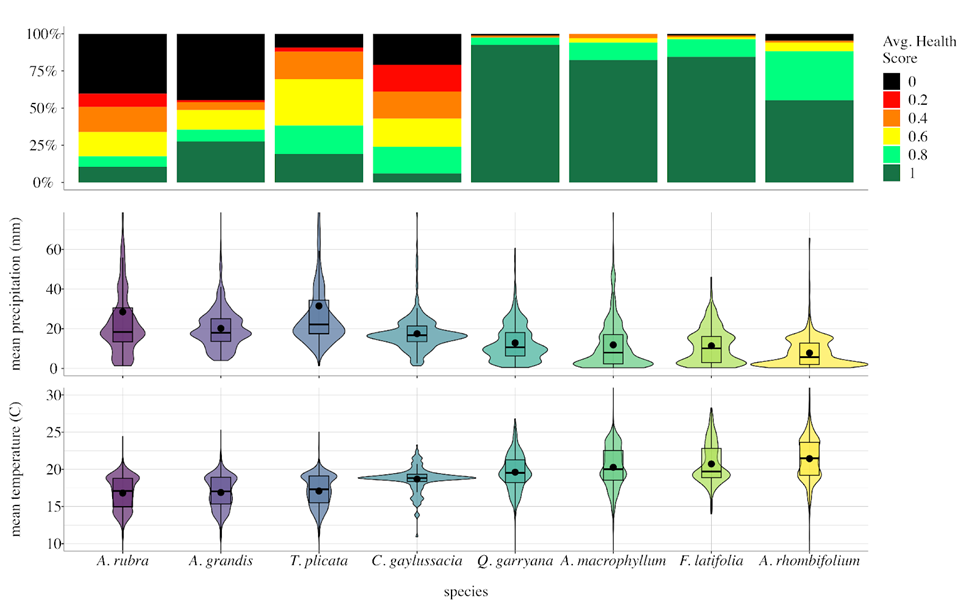
The upper row of graphs shows the distribution of tree health scores by species of hundreds of trees sampled in the Willamette Valley. The second and third rows of violin charts depict the relative niche spaces occupied by each of these eight species across their Pacific Slope ranges. The upshot of this analysis: trees with higher range-wide heat and drought tolerance are performing better now in the Willamette Valley than trees restricted to cooler and moister ranges.
A simpler way to visualize relative niches for these eight species is through their geographic distributions. The graphic below shows the centroid of all current documented localities, filtered to remove excess samples and duplicates:
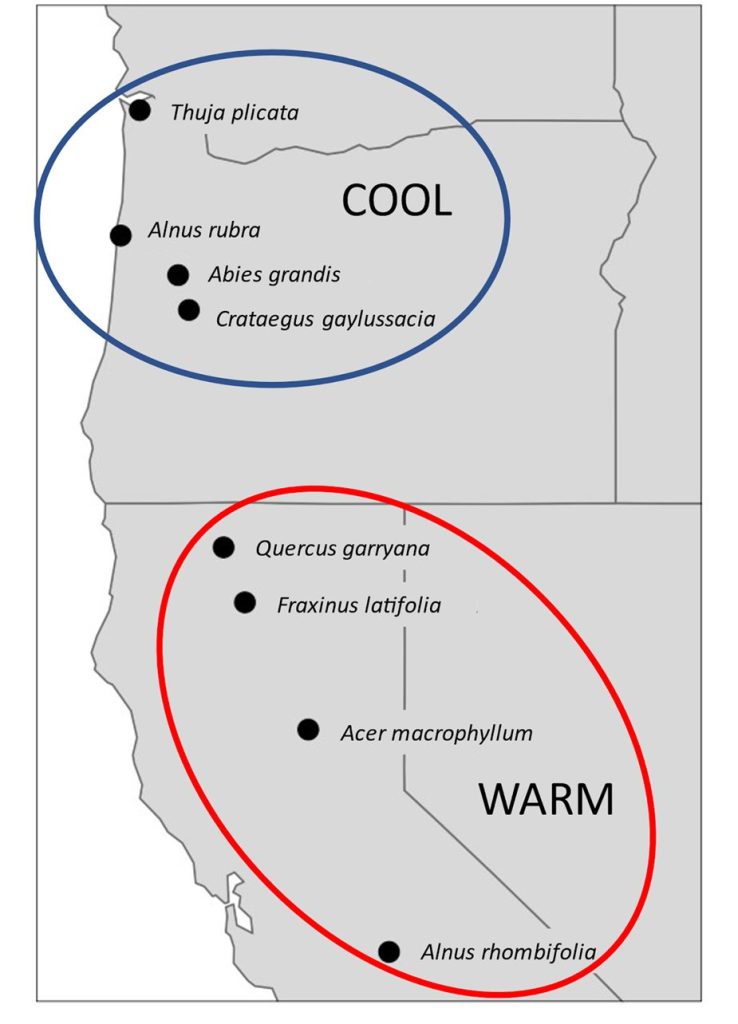
Again, the species with warmer (and drier) overall distributions are faring better. And of the four warmer-adapted species, Garry oak is faring best of all here in our part of the world.
Garry oak is a spectacular tree (see this post: https://schollsvalley.com/notes-from-the-farm-19-september-2025-more-climate-adapted-plants/ ). It’s especially on my mind now because it is acorn season. This is a middling mast year, but it looks like we’ll hit our target of about 200 gallons of acorns. This is not easy work, all this stooping and kneeling to pick up a hundred-thousand acorns, but that’s what it takes.
One nice thing about acorn picking, and seed collection in general, is the chance to go out and talk to people whose land contains these plants. The great majority of people I encounter, as I ask permission for access, are friendly, curious and supportive. I’ve met some of the nicest people in the Valley this way, and we are grateful to all of them for allowing us collect on their farms and forests, year after year.
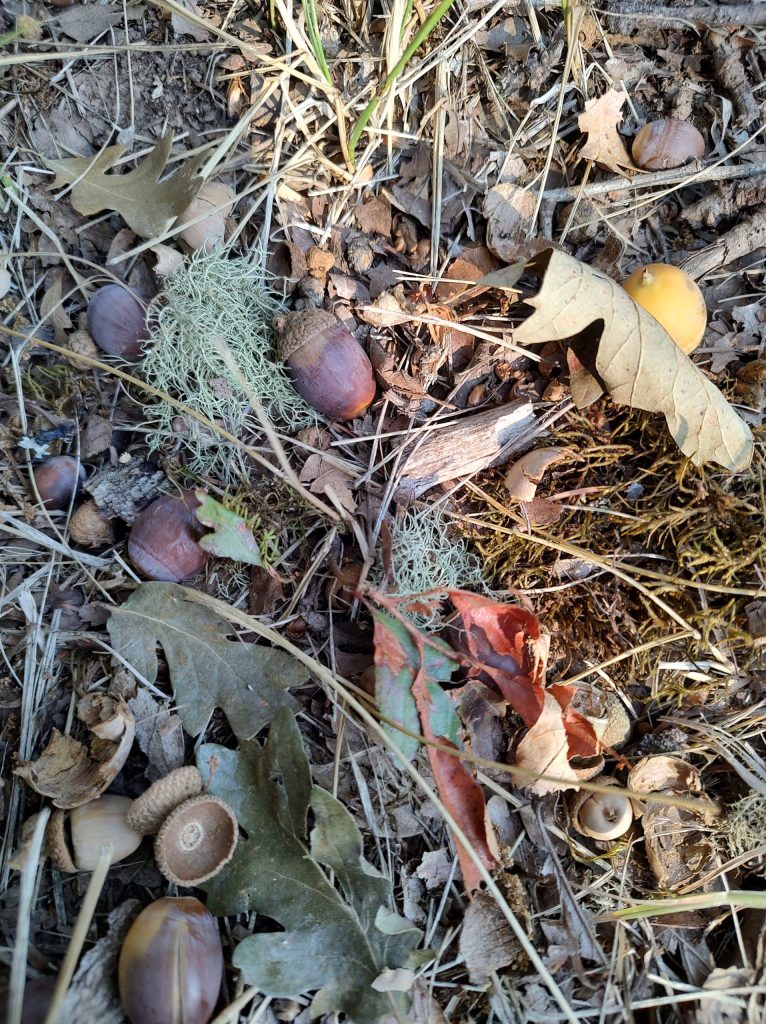
So, back to CLIMATE ADAPTED OAKS! Here is what we are hunting for these days:
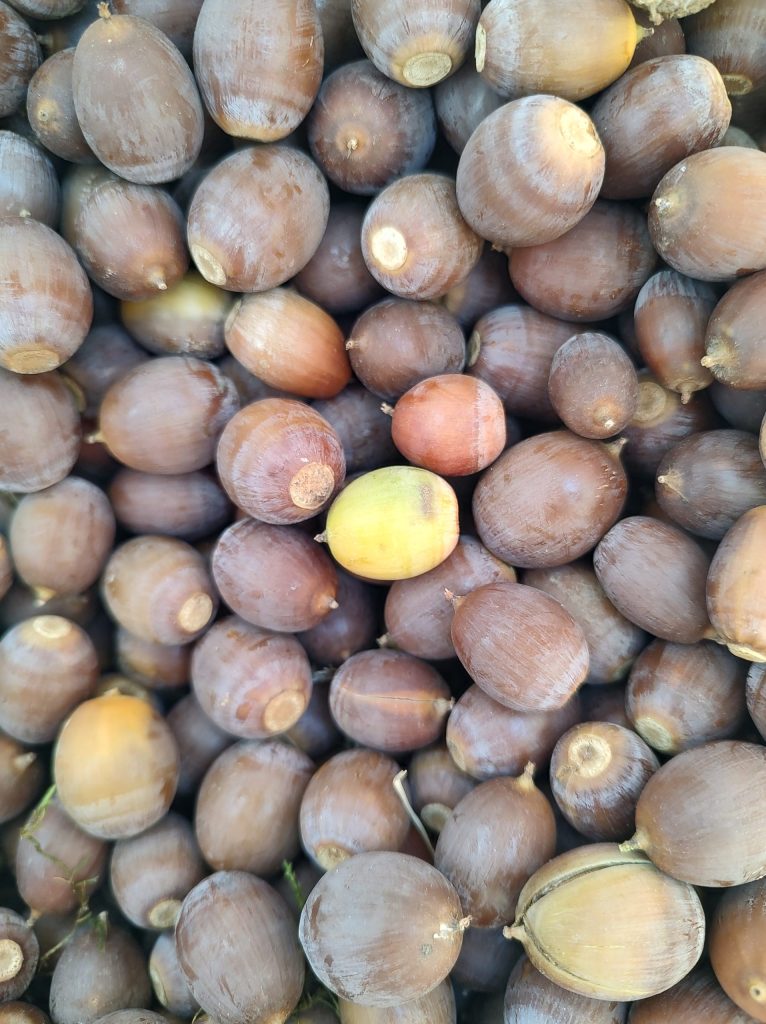
And here is what they look like in the bucket:
Garry oak is certainly adapted to climate here in the Valley. But it is a complex species which occupies a WIDE range of habitats here, from the Columbia River floodplain to flatwoods wetlands, to wet savanna-prairies, to dry grassy balds and rocky outcrops. While a fine-scale analysis of variation among populations occupying these varied habitats has not been undertaken (great PhD project), anecdotally there appears to be substantial morphological variation among trees that does seem to track the landforms where oaks occur. The facts that these trees occur in a variety of habitats, and that they show variation in form, suggest that some of that variation may be segregated by habitats, and that that segregation reflects adaptation to differing selective environments. In fact, I’ll go out on a limb, so to speak, and say this is highly likely. Which brings me to the next issue: managing genetics in nurseries and outplanting sites.
We are not currently managing multiple accessions of Garry oak, but rather a single, broad Willamette Valley accession that includes collections from both upland and valley-floor localities. Even in our highly homogenous nursery beds, substantial variation in form occurs in leaf size, outline, pubescence and seedling height. The variation we see in height is especially important. No matter how much water and nitrogen we apply, a large proportion of seedlings stop growing in mid-summer, set a bud at a 6-8-inch height, and refuse to grow any taller. So the distribution of individual seedlings by height is right-skewed, meaning the majority of seedlings are shorter than the population average. Here is what that curve looks like:
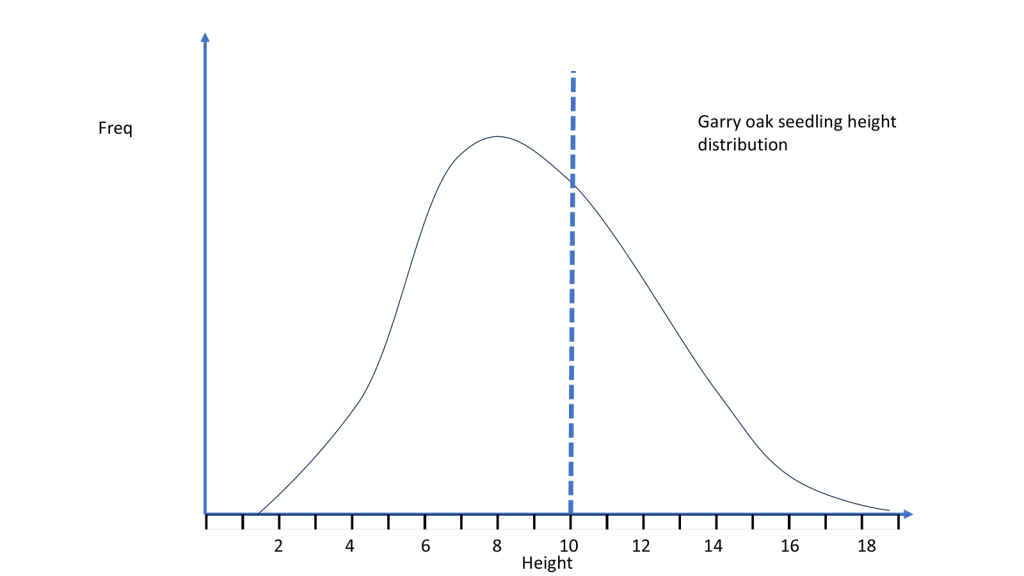
When we impose a 10-inch minimum grading standard to this population, we are lopping off not just the left tail, but the entire modal center as well.
What does that mean in terms of population genetics? Well, we would need to do some specific testing of our local Garry oak to confirm, but likely it means we are eliminating the most heat and drought-tolerant individuals from our planting sites where this standard is imposed. Trees are more or less conservative in growth for a reason – survival. Trees in rich, mesic environments must compete for light and space with other well-provisioned individuals. A tree with a conservative growth habit is going to lose in a mesic forest. By contrast, a tree with an aggressive growth habit is likely to over-grow where resources are more limited. These generalities have been well-supported in provenance tests in other species, which demonstrate that in reciprocal transplant trials, trees from harsher climates underperform on better sites and trees from more ample climates are subject to higher mortality on harsher sites.
So if we are interested in climate-adapted plants, especially since the end-points of climate change are unknown, we probably shouldn’t be lopping off either tail of these kinds of distributions. The primary rationale for rejecting small oaks has been that they are hard to find in tall weeds. Instead of rejecting 75% of the Garry oaks we produce, I’d like to recommend that land managers do a better job prepping sites for oaks of every size, and mark all of them with stakes. We have burned hundreds of thousands of oak seedlings over the decades because they didn’t make size, not because we didn’t grow them properly, but rather because they simply aren’t wired to grow fast even when we juice them with water and N.
This doesn’t make them bad plants. It makes them adapted to a hotter, drier climate.