
Hi Folks,
Yep, it’s a beautiful world. If only we can keep the sociopaths from destroying it. But that is a topic for later in the week. What can you do today? How about you buy some cherries?!
The chokecherry (Prunus virginiana var demissa) is another great climate-adapted local plant that is actually thriving right now in the Willamette Valley. I have heard a number of people comment recently that they are noticing this plant more frequently these days, although it is still often overlooked as it tends to blend in with other members of our rich riparian shrub flora.
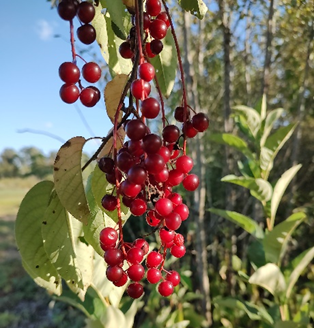
In our neck of the woods, chokecherry is an occasional shrub or small tree along rivers and streams, and also on rocky, exposed upland slopes. It is a robust, highly drought- and heat-tolerant plant that performs well on most mesic to droughty sites, despite our increasingly hot, dry summers. Chokecherry produces long, delicate racemes of white flowers in late spring which attract swarms of bees – particularly solitary bees but also bumblebees. Properly pollinated flowers go on to produce vivid red-orange, translucent cherries, strikingly presented in long chains amongst the leafy branches.
Chokecherry was an important food source for local tribes. Its fruits were eaten fresh and also processed and dried for later use. At the peak of ripeness, they are actually quite sweet and tasty and are rapidly devoured by birds. A great plant for both pollinating insects and fructivorous songbirds, chokecherry is an ornamental native that is uniquely adapted to the rigors of our increasingly droughty streambanks and rocky slopes. When water-stressed, it can drop leaves and set buds as early as mid-summer, going into a dry-season dormancy that is almost impervious to summer drought. Chokecherry is one of the few species in its genus to produce actual rhizomes, which spread widely to form large clones. Outplanted seedling survival is generally high, making chokecherry a great choice for riparian and upland plantings.
Please buy some and then plant them for the birds and the bees! We have about 7000 in stock right now.