
And unfortunately it’s not a good one.
All the hard work folks in Oregon have done to manage landscapes sustainably, and the hundreds of millions of dollars spent on water quality and salmon recovery don’t amount to a hill of beans. Why? Two reasons. First, we aren’t learning as we go, a necessary step toward more impactful, positive results. Second, the folks who manage the vast majority of working lands in this state are going in the exact opposite direction. I’m talking about ag and forestry. It doesn’t work if people are working at cross-purposes. Right?
On the forestry front, the liquidation of western Oregon’s natural forests initiated by corporate raiders and vultures beginning (for the second time) in 1990 is now complete. The last stand of native timber remaining on industry land was cut last year in Washington County. That’s it. It’s gone. And this year, for the first time, industry has nothing left but actual plantations of genetically “improved” Douglas-fir super trees. They are now milling small logs from these 30-40-year-old plantations, generating coarse boards and OSB-type products in highly mechanized mills that are the very lowest quality of products that can possibly be produced from western Oregon forests. Or they are gluing together these cheap boards to create “engineered wood” products in an attempt to manufacture what nature does better. This is the sad result of 50 years of academic, industry and government silvicultural research and tree breeding programs – super trees.
Super? Really?
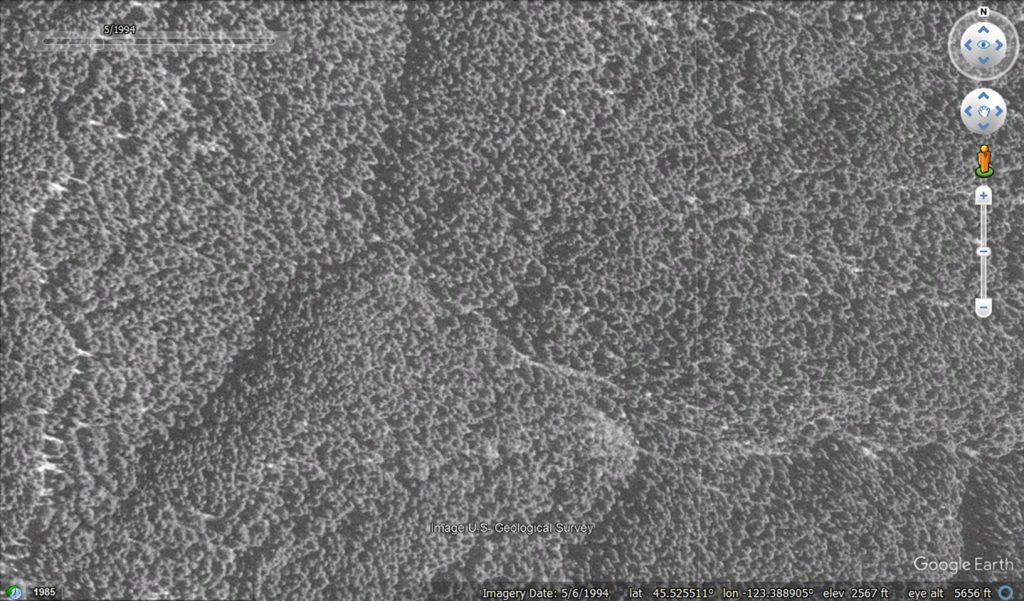
Here’s the upper Tualatin watershed in 1994, covered with the natural forests that came back after the first going-over Big Timber gave it in the 1920’s and 30’s. The stands that established themselves naturally were diverse – Doug-fir, cedar, maple, hemlock, grand fir and many other species of native trees shrubs and herbs. None of these trees were planted. Not one. They came back on their own in spite of Weyerhaeuser et al who had cut it over and left it for dead. Who knew?
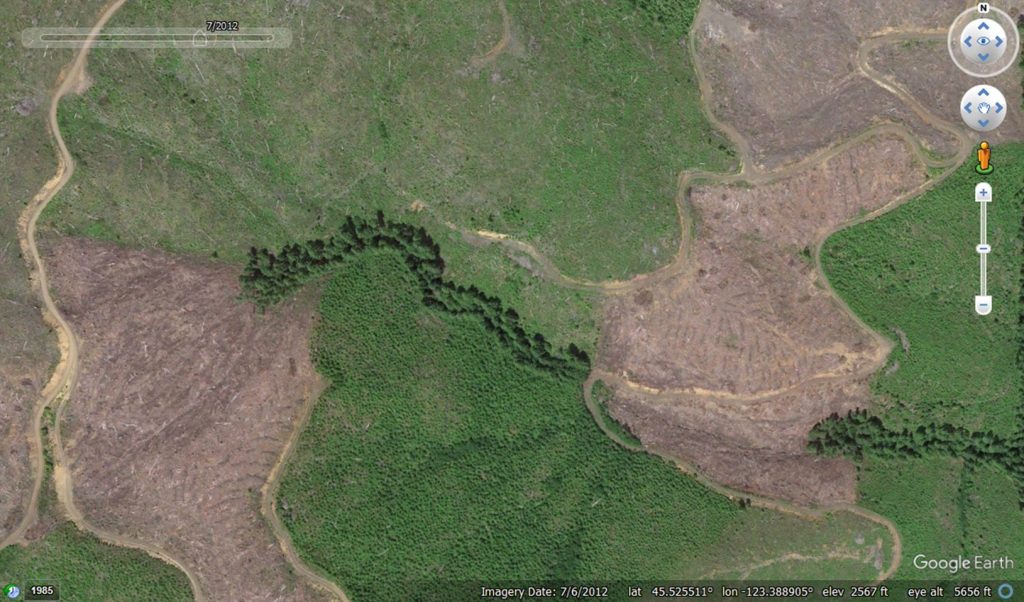
Here’s what it looked like after they gave it the second once-over. The recent clearcuts are gray because industry pasted them with herbicide “cocktails” (their word, not mine) that kill native plants for years so they can grow their super-trees faster. Every single tree planted in the image below is a Douglas-fir super tree. It’s a vast Doug-fir monoculture. SIX MILLION ACRES of western Oregon now look like this, and the current plan is to cut a third of it every decade, keeping it in this state permanently. With each successive rotation, what little native diversity escaped the last barrage of helicopter spraying will be eliminated. It’s about as sterile a landscape as we can make of the Coast Range, blessed by the Oregon Department of Forestry and our entire state government.
For those of you who don’t know the history of western Oregon, here’s a brief summary. After the US Government divested the tribes of nearly all of Oregon, it began to give those lands away to railroads and settlers. Millions of acres were granted outright to rail companies. Settlers snatched up small parcels mostly in the valleys. Weyerhaeuser and other timber outfits, having annihilated the great pine forests of the upper Midwest, began to look toward the Northwest as the next big cash bonanza. They acquired millions of acres of the best timberland in the Northwest, home to the most massive, highest quality conifer forests on the planet. Some of it they bought on the cheap from their friends at the railroads. Much of the rest of it they acquired through a variety of corrupt practices. Basically, they stole it from the American people who had stolen it from the tribes. Then, beginning in the early 20th century, they mowed it all down. I watched the very last of it being cut, on the OP in Washington, and on the Mohawk in Oregon, and on the capes along the coast in the 1980’s. People today wouldn’t believe what those trees looked like, laying on the ground or cut into logs and hauled out on trucks. Three-log and even single-log loads weren’t that uncommon. That was just forty years ago. And the rich? The rich got richer.
But the folks on the ground? They had decent and purposeful lives. They made wood for people’s houses and shops all over the country, and it was the best structural wood that was ever made in the history of mankind. And also durable shakes and shingles for roofs and siding, much of it still siding houses fifty and 100 years later. And finish wood of all kinds – doors and window sashes that didn’t warp. Wood panels. High-quality veneers and plywood. We made beauty and structure and value for people from these beautiful ancient trees. And small towns and cities in Oregon were alive. Oakridge, Idanha, Mill City, Grants Pass, Springfield, Sweethome. They had good schools and stores and community. A future. Yeah, there were ups and downs, but over the years, there were jobs for anyone that wanted one. The “homeless problem,” by and large, didn’t exist.
And then, in 1992, it was over. A whole state and all of its towns and people got the cold shoulder. Fourteen million acres of federal lands were abruptly locked up. Mills shut down. Tens of thousands of jobs were lost. Stores closed. Families fell apart. Whole cities lost their sense of purpose. These were people, and they suffered, and that suffering reverberates through what is left of Oregon’s timber towns over thirty years later. They are ghost towns compared to what they once were. Their vitality is gone.
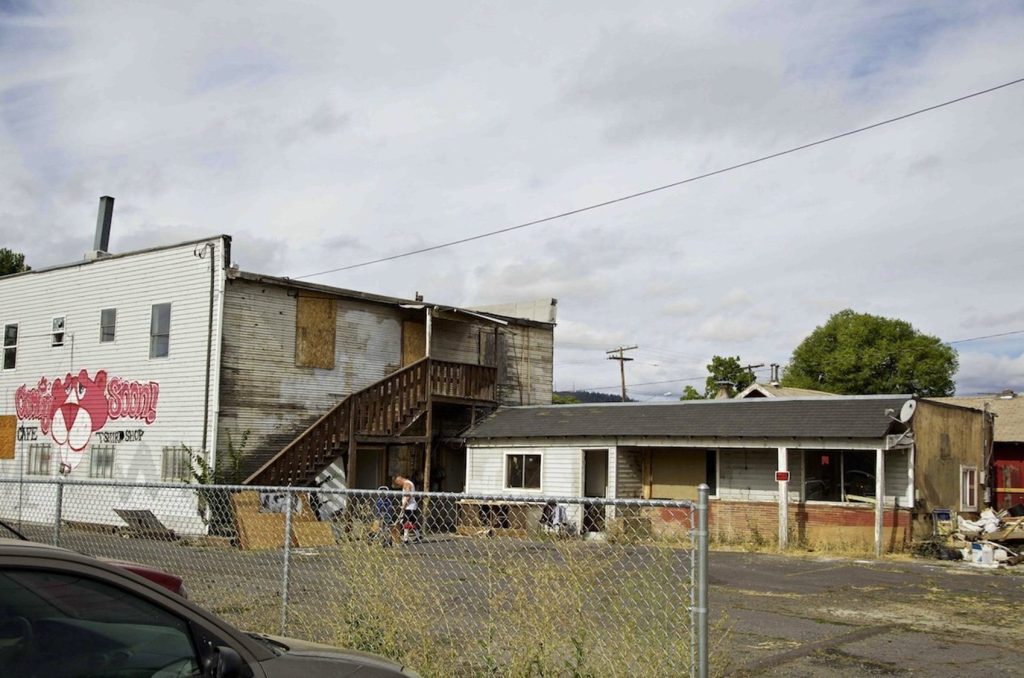
But the corporate types? Oh they are doing fine. Their timberlands, stripped off and left for dead, actually grew back. And thanks to their back-door deals with the Clinton administration to kill the federal timber program, they made tens of billions from the second round, now complete as you now know. Having wiped out the competition, their ill-gotten timber was worth far more than it would have been. Anyone who thinks this was just coincidence hasn’t thought about it.
And now the Richey-Rich’s money is safely locked up in their vaults. And what did we get out of the bargain? More stumps. Just smaller ones this time. And coarse, ugly boards – fifty percent sapwood and fifty percent juvenile wood – that will not stand the test of time. THIS is forestry in Oregon. Sad.
Don’t pretend this nightmare doesn’t reach Portland and Salem. It does. Every person in this state suffers from the tragedy, loss and wreckage of this sad history, starting with the tribes, then the timber towns, and now the thousands of people who live on the streets. THIS IS US. The people at the top of the Timber Industry and all of their predecessors are at the bottom of this disaster. They engineered every single act. They shoved the tribes aside. They grabbed the land and all its resources, they took advantage of the people doing the actual work, they wrung every drop of life and treasure they could from it all, and they laughed all the way to the bank. They got governments and universities to do their bidding and cover for them. They own it all. And they own you.
It’s time to wise up, folks.
More later. It’s so sad right now but it could be so good. Gotta hang onto that.
-George