
In their 1969 treatment of Pacific Northwest Iris, Hitchcock and Cronquist noted that Iris tenax, the Oregon iris, with all its remarkable variability in color, was especially to be enjoyed along Willamette Valley highways. Unfortunately, decades of roadside and grass field spraying have reduced this once common plant, and it is now exceedingly rare along most of our highways and byways. What a needless shame. Iris tenax is aptly named – it is indeed a tough, drought-hardy plant that took well to our gouging out roadways – Oregon iris is seemingly made to grow on cut slopes..until you whack ’em with 2,4-d. Then it’s curtains.
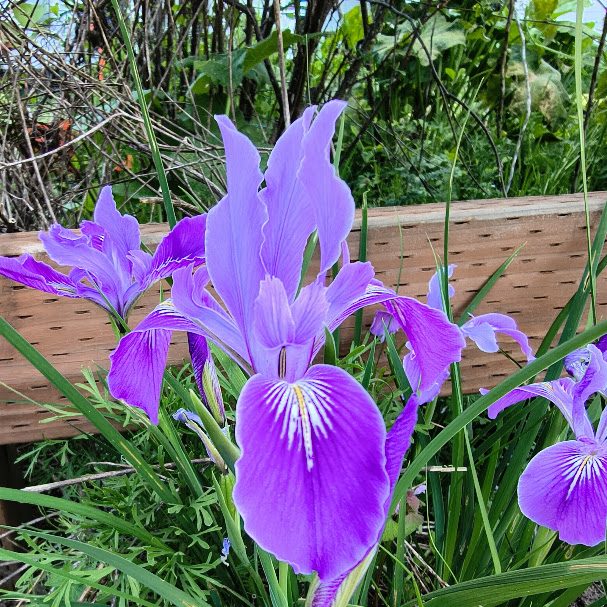
This is easily one of Oregon’s most strikingly beautiful plants. And it’s a magnet for pollinators and all kinds of arthropoda and their shenanigans. All you need to do is sit down by a patch of it and watch. First, you’ll notice the bumblebees, like this big Bombus vosnesenskii (click the link):
https://photos.app.goo.gl/wcKhRKX6Myse231T6
Then you’ll see other smaller bumbles. And honeybees. And solitary bees of all sorts. This plant is an absolute magnet for bees, and no wonder. It’s designed for them. When you peel back a sepal, here’s what you’ll see inside:
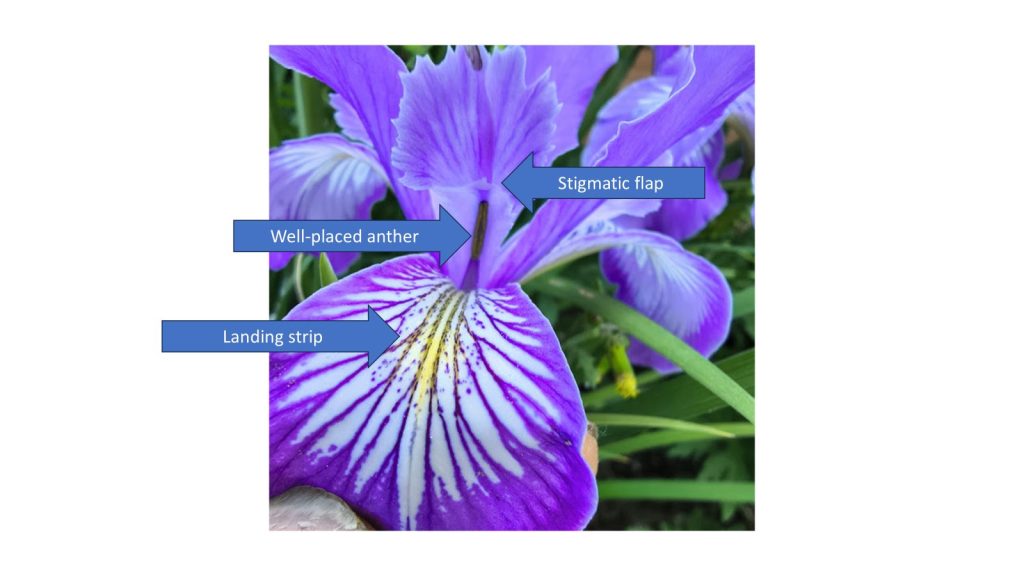
The sepals presents a vividly lit landing strip for even our largest bees. The veins guide the bee toward nectaries at the juncture of the perianth tube and sepals. As the bee travels down the well-marked path, her back, likely coated with pollen from a previously visited iris, brushes across the stigmatic flap, and then the anther. This order of operations, dictated by the structure of the flower itself, increases the likelihood of outcrossing. When she backs out, the flap closes, preventing the flower’s own pollen from contacting the stigma.
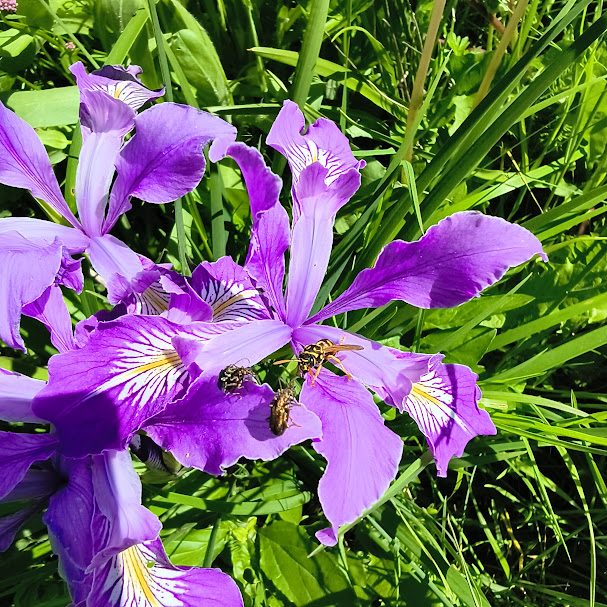
Beyond bees, all manner of other insects are attracted to these gorgeous flowers. Beetles, hornets, flies and others are likely pollinators, or in some cases nectar robbers, sneaking in between the petalloid style and sepal to get directly at the nectaries. But even with a few robbers around, the Oregon iris frequently produces good crops of seed. In the above slide, a voyeuristic hornet appears to be enjoying a veritable orgy of metallic beetles, many of which were having a good time in this particular clump of iris.
The next challenge is to get them to reliably germinate. Our crop of iris this year is going to be lousy, mostly due to a pesky invasion of horsetail. But we’ll have a few to spread around, and hopefully repopulate a few places where they’ve been wiped out.
For Pete’s sake, and ours, let’s please stop spraying everything. Call ODOT and your county road dept today. Holy cow..unbelievable. It’s 2026 folks.
-George