
It’s been over a year since I last posted about walnut in the Willamette Valley. Our local WV population is a hodge-podge of walnuts, mostly the Claro walnut (Juglans hindsii) from California, black walnut (J. nigra) from the eastern US, and Juglans regia, the English or Persian walnut. All three of these species, and possibly others, are variously interfetile, and all are contributing genetics to a growing wild population of walnuts that are popping up all around the Willamette Valley, especially along streams and rivers.
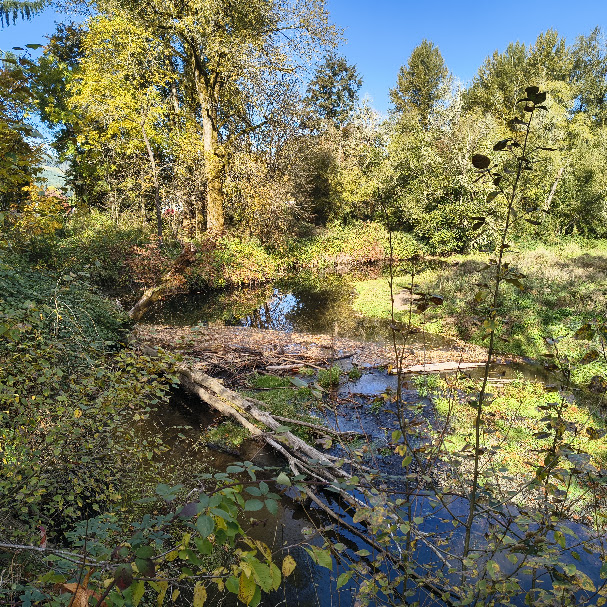
Fall is a great time to spot walnuts among our other riparian trees and shrubs, and to distinguish woody plants generally, as leaf cells break down chlorophyll to reveal their unique and diagnostic underlying colors. Now, instead of walls of green, we see a rich mosaic, from the gold of bigleaf maple to the purplish red of the western crab. Most walnuts color to a bright, clear yellow, much brighter than ash, and looking around now for their long, bright-yellow pinnate leaves reveals that these plants are everywhere along streams in our neck of the woods.
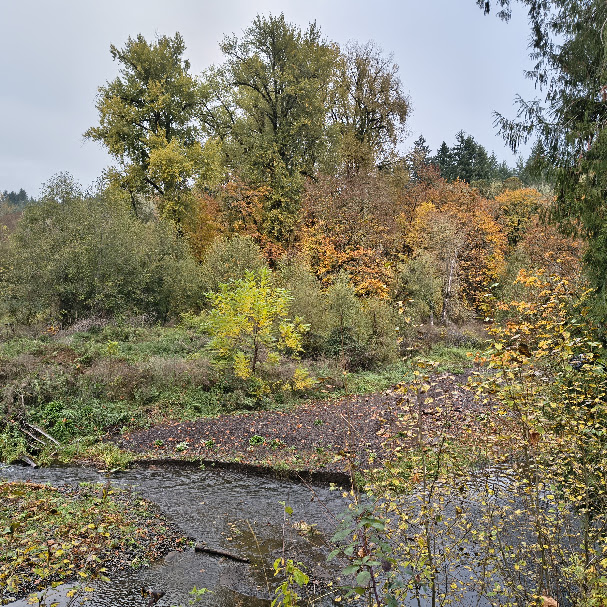
As I mentioned in my last post on walnut in the Willamette Valley, these plants are here to stay, and like it or not, they will definitively be part of our arborescent flora for the foreseeable future. With the imminent demise of Oregon ash, this is nothing but a positive development, and one we should embrace and encourage. Some features of these wild walnuts:
- Fast-growing
- Highly shade tolerant
- Heat tolerant
- Valuable to wildlife (and humans. The nuts are delicious)
- Durable large wood (for wood products or stream structure)
- Thrive in alluvial soils
- Fantastically valuable hardwood resource
Due to the inclusion of J. hindsii, this population also appears to have some innate resistance to walnut twig beetles and the fungi they vector, causing the “thousand cankers” disease. This disease complex, native in the southwestern US and Mexico, threatens walnuts elsewhere, most notably black walnut in the eastern US, and is certainly affecting planted black walnut here. But most of our wild trees appear vigorous and unaffected. It would appear that the inclusion of resistance genes from Claro walnut in our wildly heterozygous welter of hybrids is generating a new population of walnut that is well-adapted to today’s Willamette Valley – despite and because of the invasion of insects and increasing summer heat and drought.
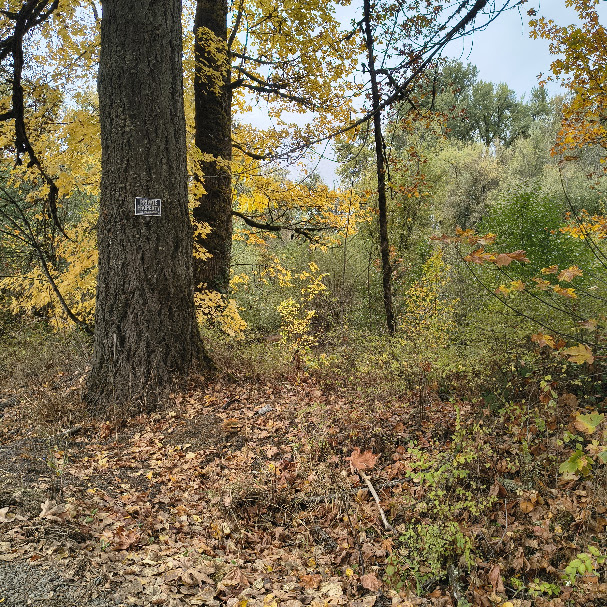
The appearance of walnuts in our flora should be no surprise under a warming climate. The claro walnut in Cailfornia is a warm-mediterranean-climate-adapted tree and a major element of riparian forests in its native range, along with bigleaf maple, ash and cottonwood. The accepted native range of Juglans hindsii now extends north to Douglas County, quite possibly facilitated by pre-Columbian trade among the tribes. Modern Americans have simply further facilitated this migration. It’s puzzling that we immediately and inherently reject our own plant introductions while embracing that same past behavior by the tribes. Yes, our moving stuff around has generated a storm of massively disruptive waves of new species, frequently displacing and wrecking native ecosystems. But a species-level analysis of these introductions reveals that most introductions come with environmental pluses and minuses. In the case of walnut, the pluses seem, at the moment, to outweigh the minuses. And again, either way, they are not going away. So let’s make the most of it.
There is currently no better alternative for the immediate replacement of ash in our riparian forests than the Oregon walnut, a proximately native population composed mostly of genetics from walnuts to our south and east. We now clearly have a climate that supports Juglans exceedingly well, making migration of nearby walnuts all but inevitable, with or without humans. So please buy some walnut and start planting them under ash this winter. Now is the perfect time to do it. Just log into the shop, scroll down to Juglans hindsii X nigra and order as many as you can use.
‘Til next time,
-George