
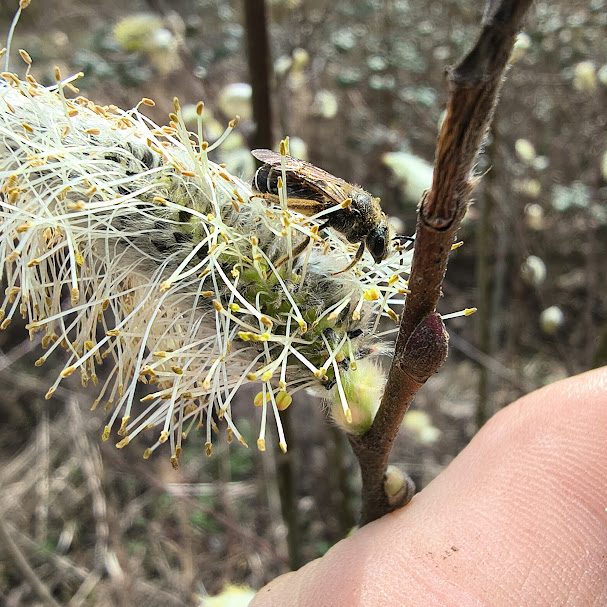
We tend to think of willows, with their long stamens and dioecious nature, as wind-pollinated, but bees certainly play a role in moving willow pollen around. In fact, willows attract swarms of bees of many kinds, from tiny solitary bees to honeybees to bumblebees, and Scouler willow in particular does it at a time when pollen and nectar are relatively scarce, in late winter. Interestingly, both male and female plants produce nectar, with nectaries tucked into the catkin scales of both sexes. Here is a little solitary bee (one of many) visiting a male catkin of a young Scouler willow:
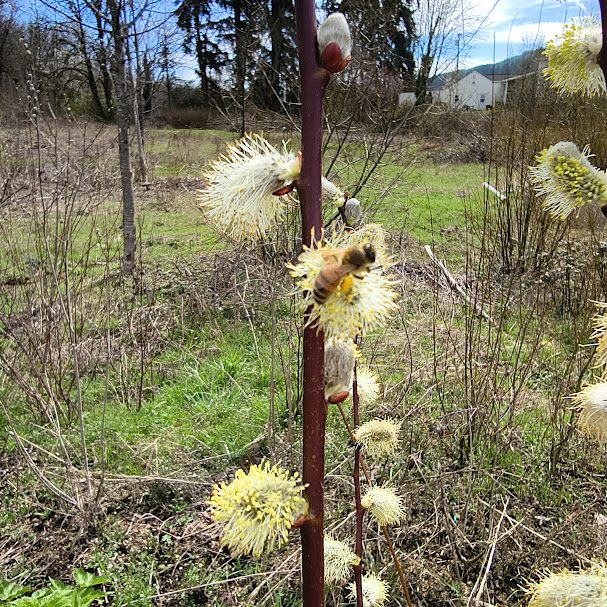
And here is a honeybee visiting another young male nearby – check out the pollen load this little gal is packing along:
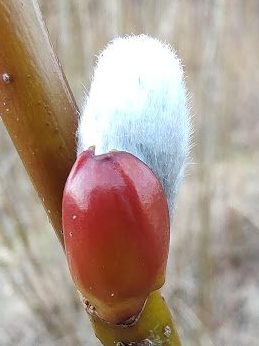
Scouler willow often hybridizes with Piper willow (below), which also blooms early. Both species have large fertile buds, but those of Piper willow typically sport smooth, lustrous bud scales.
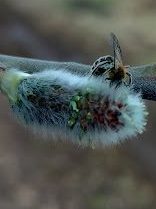
Besides being critical elements of many western and boreal habitats, willows are beautiful plants, wonderfully varied in their form and color. Take a look at willows near your neighborhood stream or wetland right now, and you’ll likely see and hear bees. Peering through a handlens at the catkins reveals their hidden beauty.
Happy spring!
-George