
If you are a plant population biologist, what’s not to love about willows? Don’t get me started…oops..too late!
Earlier I introduced to you an undescribed hybrid between Salix prolixa and Salix sitchensis https://schollsvalley.com/notes-from-the-farm-28-september-2025-more-climate-adapted-willows/. This hybrid has emerged spontaneously here at the farm, and it has almost certainly emerged in other locations where these two species coexist in the wild.
The F1’s we have here exhibit a number of distinctive characteristics. Many of them are clearly vigorous, outgrowing the surrounding Sitka willow, its maternal parent species, as well as the paternal MacKenzie willow growing in an adjacent row. I listed out a number of vegetative features for which the F1’s are intermediate between the parents. And now, thanks to the precociousness of willows, we can already see fertile structures – the male and female catkins and their constituent flowers. These, too, exhibit intermediacy between the parents. For instance, male flowers of Sitka willow support a single stamen, while the male flowers of MacKenzie willow each have two distinct stamens. Male flowers of the F1’s, however, mostly have bifid stamens, generally divided at mid-length or higher on the filament, or in some cases with a single entire filament but a bifid anther. Some of the pollen sacs in the F1’s appear malformed, but otherwise the pollen produced appears normal under a microscope, and at least some of it is very likely fertile.
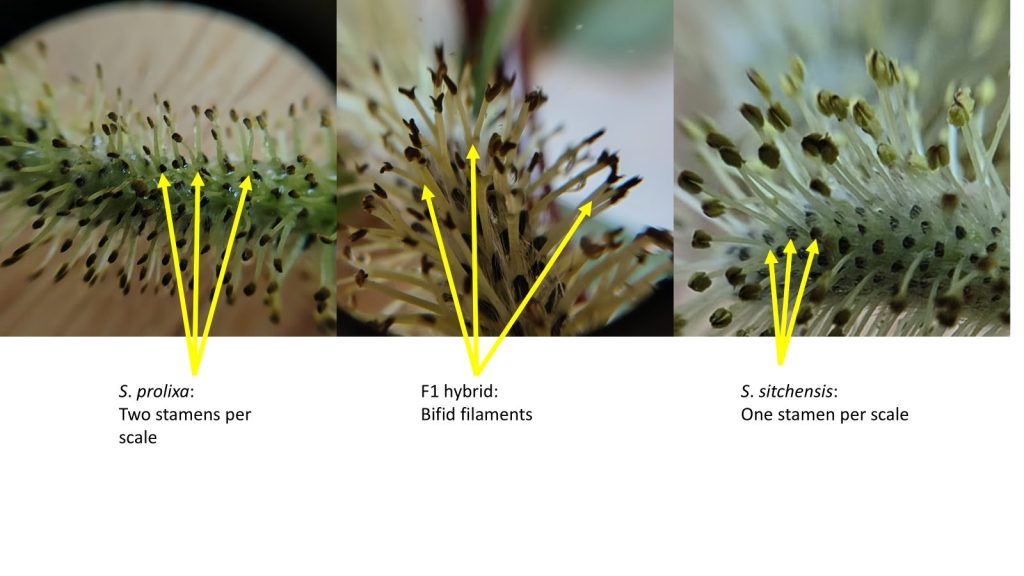
Among woody plants, willows are great subjects for studies of hybridization and inheritance. They have numerous unique heritable features, and unlike many other woody species, especially trees, they frequently flower within one or two years from seed. This allows us to see patterns of inheritance much more quickly than in genera like Pinus and Quercus.
Inter-specific hybridization likely has multiple effects on genetic diversity, species migration, niche space, and landscape occupancy of willows. By extension, hybridization in other genera is likely having similar effects that drive the form and function of forests and other plant communities. When it comes to climate-adapted plants and adaptation to climate change, the importance of these interactions is obvious. This particular interaction between Sitka willow and the much less common MacKenzie willow gives us a window through which to view these possibilities. This interaction also highlights another issue – the issue of species diversity and its potential to support human life and well-being. This interaction would not be possible if either species were to disappear. As we march forward, applying ever more herbicides to ever more of Earth’s land mass, we continue to lose species and reduce diversity. The loss of diversity, driven by industrial ag and forestry, tends to knock out the rare things first, and if we want more endangered species and resulting ecosystem dysfunction, all we have to do is keep it up. Which brings me to the Oregon Department of Forestry.
ODF manages the Tillamook State Forest, which is to say they extract logs and spray their logging units with a variety of powerful and long-lasting herbicides. Since 2000, ODF has directly helicopter-sprayed something north of 50,000 acres of the Tillamook State Forest with herbicides, with herbicide drift affecting tens of thousands of acres more. Unfortunately, this is not their data – ODF does not publish or track such things in any way that makes analysis possible. This speaks to what this organization is. And I’ll just say it. ODF is a corrupt organization that seeks to hide uncomfortable information.
Turns out, the Tillamook State Forest is also a hotbed of biodiversity. With its craggy peaks, waterfalls and extensive areas of exposed rock and scree, it is uniquely different from all of the rest of the Coast Range and it undoubtedly harbors unknown populations of rare plants and likely many endemics that remain undiscovered. Even brief botanical outings into these wild rocky landscapes yield multiple county records. The TSF remains among the least botanically explored regions of the state. Unfortunately, ODF continues to torch this remarkable landscape with their chemical “cocktails” every single year. They do this to support faster growth of a single species – Douglas-fir. They are turning a biological wonderland into a tree farm.
I have nothing against logging. Done right, it provides humans with good wood and heathy materials for houses. Wood is vastly better than plastic and metal, and we truly can grow wood and still have functional forests and wild landscapes. But not the way ODF and industrial forests are being mangled today.
It is way past time for the wanton annihilation of biodiversity to stop. It shouldn’t happen anywhere, but holy moly how is it still happening today in 2026, on the Tillamook State Forest?
Assuming you are so inclined, please call the Forest Grove District and the Tillamook District offices. Tell them that you do not think it is a good practice to spray herbicides on landscapes covered with unknown populations of native plants. Ask them what kind of botanical inventory they have done prior to their spray jobs. Ask them to provide data on the number of acres sprayed, the observed effects of these applications on native plants, and the nature of vegetation that comes back afterwards. How much and what species of native cover returns? How much of it is displaced by non-native weeds? What is the effect of their aerial herbicides on vine maple, for instance, some populations of which may be thousands of years old? I’ve seen it. In many of their sprayed-out clearcuts, the vine maple is just skeletal remains, and none is returning. That’s just sad. And I have to say it again, our own state government has the gall to throw money at bee surveys and ask why we are losing bees. Who is running this show?
Here are the names and numbers of people to call:
Eric Perkins, Forest Grove, Acting District Forester, 503.357.2191
Kate Skinner, Tillamook District Forester, 503-842-2545
‘Til next time,
-George