
Our species concepts are challenged in groups like Delphinium, which includes our western larkspurs. The 200 or so species of this large genus form a series of syngameons that cover much of the northern hemisphere. Species in Delphinium are ecologically, seasonally or geographically isolated, but the actual barriers to hybridization, in the event that pollen of one species meets a stigma of another, appear to be largely absent. So where they co-occur, hybridization and introgression are almost a certainty. Even European species are apt to cross with our western larkspurs if you plant them together in the garden.
So what is a species anyway? We have the biological species concept, microspecies, ecological species, morpho-species and more! This eternal question continues to boggle minds and confuse taxonomy in many plant groups. It is probably best, as Grant suggested 50 years ago, to chill out and not get too worked up about what is or isn’t a species. In this view, if a population is morphologically distinctive and fills a certain more or less definitive niche, then it probably deserves a name so we can describe and discuss it, no matter which species concept it may fit. I tend to agree with this approach, and I think most plant taxonomists also agree. Then things get complicated anyway. It’s all in the details.
Back to larkspurs. Why do they form syngameons, which allow for the breakdown of species barriers, possibly resulting in maladaptive hybrid progeny? Precisely! Maintaining porous species boundaries allows plants to adapt to changing conditions. When we muck around and disturb habitats, botanists have frequently observed that hybrids proliferate in these altered landscapes. This phenomenon has been noted in pine, ceanothus, iris, hawthorn and other groups of species that are ecologically isolated but genetically intercompatible. Sure, some of the hybrids will be maladaptive in a given habitat, but some will have traits that help them thrive in the new habitats we have opened up by our mucking about. Roadsides, clearcuts, farm fields, pastures and other human-created or disturbed habitats are new and different from what came before. The pre-human plants might have been well-honed machines in pre-human habitats. They are likely not as attuned to the new order.
Humans are not the first bringers of ecological chaos. Many, many perturbations have happened in Earth’s history, some much larger and more profound than us. But our thumbprint is uniquely, weirdly human, what with our biological exchange program we have imposed on every continent, even including Antarctica. Not to mention CO2 enrichment, plastics, heavy metals, and an unbelievable array of toxic, mutagenic, carcinogenic, and endocrine-disrupting organic and pseudo-organic compounds. Wow, humans are creative..and destructive.. creatures. We have changed the face as well as the atmosphere of the Earth, and every species is going to be challenged to survive what’s next. Those with compatible congeners, like our larkspurs, may have a better time than those singleton species that have to go it alone.
So it’s a good thing we have so much biological diversity tied up in these inter-compatible species groups. The syngameon is a beautiful thing, and so are larkspurs. Enjoyed by bumblebees and hummingbirds, larkspurs are a major source of nectar at the front end of the growing season. Our main focus here at the farm is Delphinium trollifolium. This tall, shade and sun-tolerant species specializes in woodlands and woodland edges that are moist in spring. It is common along streams and rivers in the Willamette Valley and south through the Coast Range to coastal northern California.
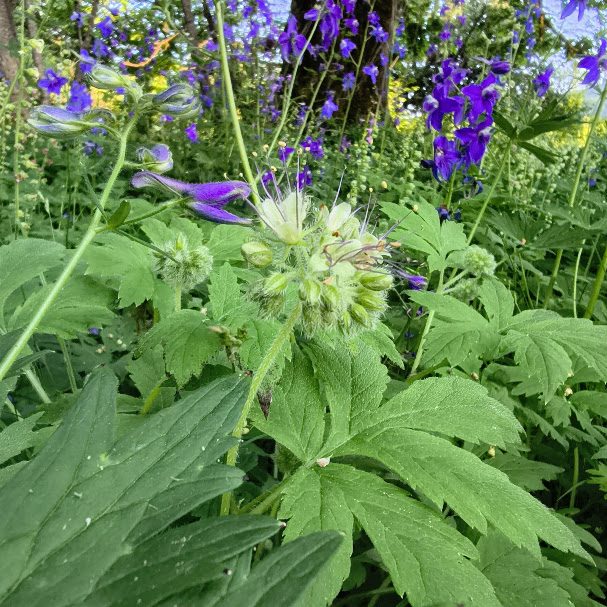
Columbian larkspur is a gorgeous plant, easy to establish from its woody tubers. These tubers are able to dry down to a crispy black, amoeba-to-octopus-shaped tuber. We count them out, pack the crispy critters into a bag and you can buy some, plant them almost anywhere, and they will give you and the bees and hummers a lot of joy next spring. You can buy them here:
https://schollsvalley.cropcache.com/shop?season_year=2026