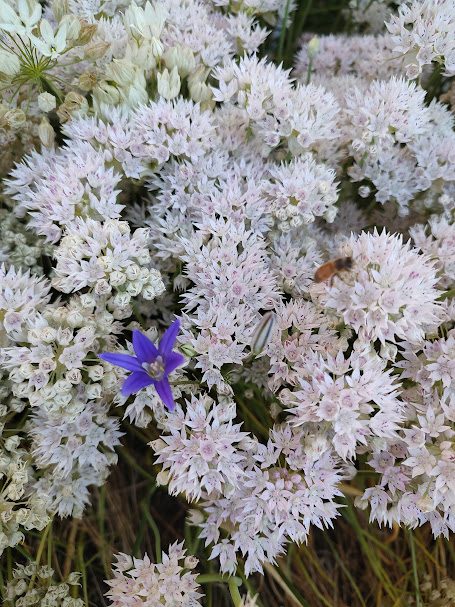
You know you are in a real prairie if you find any of our prairie lilies among the grasses and sedges. Harvest brodiaea, hyacinth brodiaea, common camas, narrow-leaf onion and others were once common in the Willamette Valley, but the vast majority of them have been plowed and sprayed out of existence. It is one of our goals here at Scholls Valley to make them common once again.
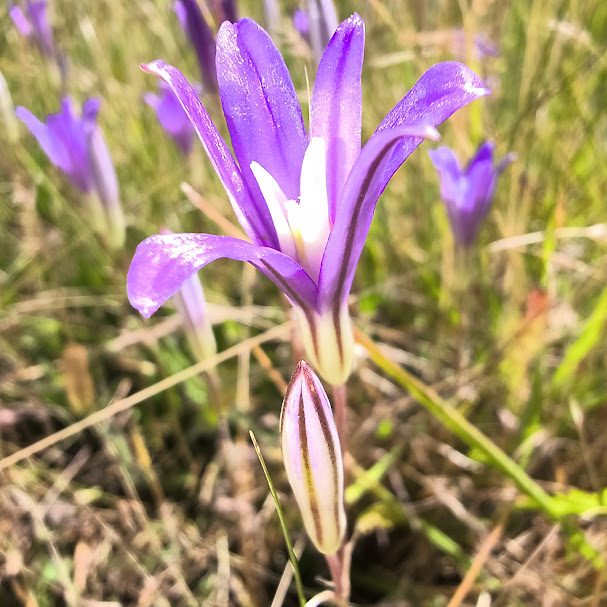
The floor of the Willamette Valley and surrounding foothills encompass well over 2 million acres. Most of those acres would have had substantial representation of one or more species of these lilies. Very conservative estimates of bulb counts per acre suggest that there would have been many tens of billions of bulbs across this landscape. So how do we bring back these lilies at a meaningful scale? It’s as easy as 1, 2, 3! Here is the 1-2-3 method:
- Prepare the ground: If you are starting with a farmed condition, simply work the ground. If you have a chisel plow or similar implement, you can use it to create furrows that will help properly set the bulbs. A very large cover-crop disc can also do the trick. If the site is covered with grass and other vegetation, you can scalp or blade it off with a dozer or tractor blade/bucket. Or you can even scalp spots by hand. If there is no or very little vegetation, as on an old road or roadside, you can skip straight to #2.
- Scatter the bulbs: You can sling them onto your prepared soil by the fistful or the bucketful in whatever spacing and distribution you like. I like to toss out big drifts of single species. Do not worry about right-side-up – the bulbs will right themselves just fine in a single season. On restoration sites, try to match species to soils and hydrology, with Camassia quamash, Triteleia hyacinthina, and Brodiaea coronaria on the wetter sites, and Dichelostemma congestum on the drier, better-drained soils. Camassia leichtlinii is a half step above C. quamash, often under oak and ash. Brodiaea elegans and Allium amplectens float in between all of these, with Allium probably having the greatest amplitude. I have found narrow-leaf onion on high, droughty balds and in saturated muck.
- Cover: In the farmed condition, your scattered bulbs will mostly roll into the furrows. Now all you have to do is flatten out the ridges with a roller-harrow or chain harrow and most of the bulbs will be perfectly set. If you are planting onto unworked ground, just cap the bulbs with 2-3 inches of compost, sand or whatever soil or mulch you have handy. The bulbs will push up through next spring. One word of caution: if you are working on a prairie site and intend to use fire anytime in the next three years or so, cover with a mineral medium. Compost or mulch will smolder and cook your bulbs, as well as create a fire suppression problem.
Another method: our bulb-setting drill. It’s basically a no-till drill sized to run bulbs. It has two seats, and you and a friend simply drop bulbs into funnels mounted in front of the seats. The bulbs travel down the funnels and into tubes that lead to a slot in the soil which is continuously opened by two opposing discs. Behind the tube are packing wheels that close the soil over the bulbs, setting them at the desired depth. Done! You can plant thousands of bulbs per hour with this machine. This is a great option for grassy prairies that don’t have lilies yet.
Either of these methods should yield a nice dsplay for you and the bees and butterflies next spring.
More soon,
-George