
Hi folks, it’s been a while. I’ve taken a long hiatus as I am building a house here at the farm that I hope to live in for a while. My daughter and her lovely family have moved into the Farmhouse, and I have been displaced temporarily to the Tiny House, our guest house and short-term residence for family and friends. I love the Tiny – it looks out over the garden and some of our production fields. Because this is Scholls Valley, the garden and fields are teeming with life, and it is a beautiful sight to behold. There are flocks of goldfinches and white-crowned sparrows these days, picking seeds and insects from the ceanothus and sunflowers outside the window. I can walk out my door and look closely at any spot of ground and see interesting natural phenomena, replete with diverse vegetation, insects, spiders and all manner of living organisms doing their thing. Thanks to a 3-inch soaking the first week of the month, I can see carpets of tiny seedlings all vying in a battle to the death for limited space. Only 1 in a thousand or more will survive this conflict. Here is one of those battlefields this morning:
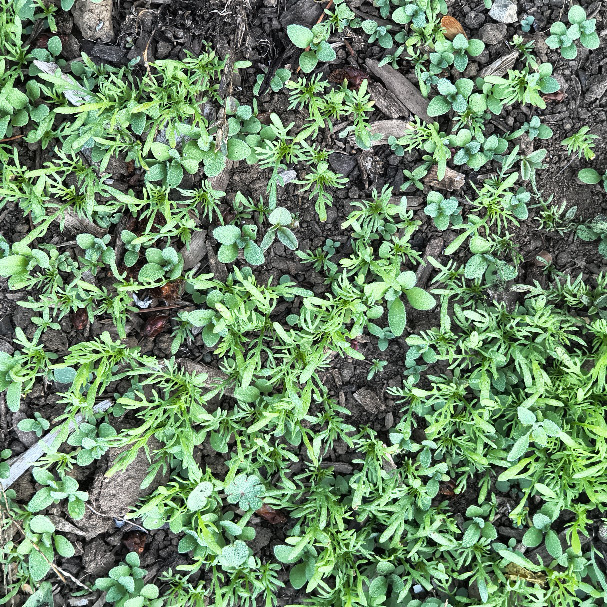
This is the essence of natural selection, and to the extent the outcome of any battle is decided based upon genetic traits, evolution is playing out, right now and every day, here in front of the Tiny House and everywhere else on the Farm. It is a miraculous spectacle, our view into the marvelous machinery of evolution. It is hard to imagine a more elegant and compelling process of creation that has yielded, for humanity, all the beauty and bounty of nature. What we do with this bounty is entirely up to us.
When I look further, beyond the limits of our farm, I see a more confounding landscape that contains some of the last tiny vestiges of natural forest remaining in the Coast Range. As I have documented in previous posts, the majority of this natural forest wonder have been leveled in the past 35 years, sprayed with plant-killing chemicals, and planted with Doug-fir super-trees. Here is what that looks like:
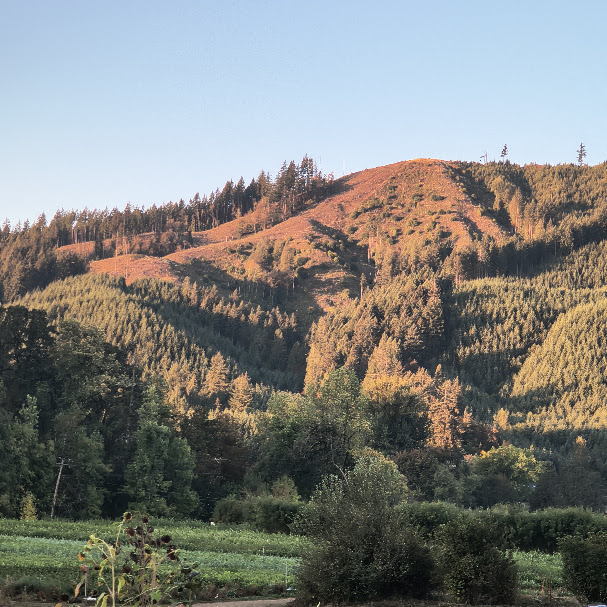
This raggedy landscape encompasses remnants of natural forest, some of which is there solely because I caught Stimson Lumber with their pants down. Also, you can see a fresh clearcut which was patently illegal but nevertheless defended tooth and nail by our own Oregon Department of Forestry and their bulldogs at the DOJ. Why our state government is using public dollars to defend private industry, and in the process, short-changing the interests of the public, is a topic for another day. But this landscape is the outcome of just such a circumstance.
Flanking the remnant forests and clearcut are 10-20-year-old super-tree plantations that my friend Jon Pampush aptly calls “Astro-turf” forests. The Astro-turf plantations are about as biologically interesting as the actual plastic grass on a ball field. The reason these plantations are so devoid of interesting plants and general biological activity can be seen by zooming in on the first photo. Here is what a closer examination reveals:
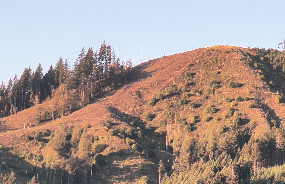
In the recent clearcut, you can see a clear demarcation slicing diagonally down the slope, from the top of the ridge and downward to the left. Below and to the right of this line, the natural vegetation of the Coast Range has regrown and covers the slope with a broad diversity of mostly native species of plants. Above and to the left of the line, most of this natural vegetation was sprayed out by Latino laborers, packs sloshing-full of herbicides and strapped to their backs, as they labored their way down this incredibly steep, slash-covered slope, squirting a cocktail of chemicals over vine maples, lupines, black-caps, trilliums and the like.
What a rotten job, backpack-spraying plant killers on steep slashy clearcuts. Normally, Stimson would have attacked this whole slope with a helicopter, but in this instance, they knew that people were watching and they were trying to maintain a low profile. But anyone can see the result, and since they generously left the natural vegetation in the watershed of my neighbors drinking-water stream, we have a rare view of what the Coast Range should look like five years after logging, immediately abutting what the corporate and ODF foresters have turned most of the rest of it into over the past 35 years.
The list of species in the unsprayed area is long, and coverage of native species is high. Hazel, black-cap, blue wildrye, sitka brome, giant vetch, broadleaf sandwort, lupine, leafy peavine and many more early post-disturbance colonizers are there. Also there are the vine maple, trillium, star-flower, false Solomon’s seal, inside-out flower and all of the other understory plants. They hang in despite the blazing sun, and they take this time to become highly reproductive. In the case of vine maple, for just one instance, the vast majority of seed reproduction occurs during this brief window of high light conditions and low site occupancy.
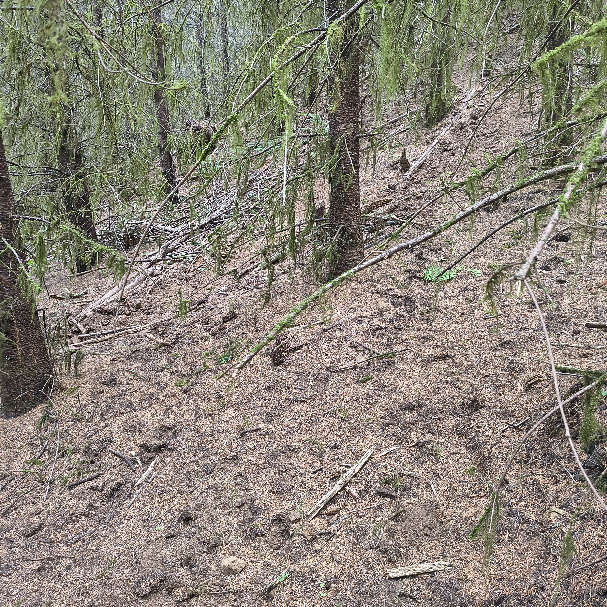
But in the sprayed area, all of this natural succession is disrupted and blighted. Triclopyr, glyphosate, sulfometuron methyl, metsulfuron methyl, clopyralid, hexazinone, imazapyr and other powerful herbicides see to it that most of this native vegetation is eliminated. So five years later, and still bearing a detectable residual of long-lasting chemicals, the sprayed-out soils support mostly a thicket of non-native, unpalatable weeds. Doug-fir super-seedlings dot an ocean of Canada thistle and velvet grass. Most everything else is wiped out, including the vine maple and the trillium that should grace the future forest. But now that future forest will not be a forest at all. It will be a spooky-looking, dead-feeling, incredibly boring plantation of a single species of highly refined Douglas-fir, the only purpose of which is to crank out boards of the lowest possible quality. What passes today for a #2 structural Doug-fir 2X6 is truly pathetic, with structurally problematic knots traversing many boards and wane on one corner of the majority of the rest. Over 10% have wane on two corners. Wane is when corners of rectangular boards are missing. It happens when mills try to cut too many rectangular boards out of puny, low-quality logs. This is the trashy wood I am forced to build my house from, because there is nothing else available. Stimson, Weyerhaeuser and the rest have seen to that.
Folks, the corporate shills, lobbyists and strategists have controlled all of us. They control the markets, what you can buy, what you can afford, how you work. They own and abuse most of the Coast Range that you can see on your western horizon. They own Oregon State University and they decide what “science” prevails there, and they determine what government does and does not do. What government does falls into one of two categories: 1) things that are beneficial to corporate interests, and 2) things that are irrelevant to corporate interests. Things that are contrary to corporate interests may crop up from time to time, but every single one of these is either squashed or subverted to serve corporate interests. Or made into a ridiculous and irrelevant joke, which in its own way, serves corporate interests. A functional, rational government serves the public well. The fat cats that run the planet don’t want that.
Consider California’s Prop 65. This law started out as a laudable attempt to reveal the serious hazards posed by hundreds of thousands of harmful man-made chemicals foisted on an unsuspecting public by profit-crazed corporations. But then California bureacrats went wild and now Californians are wondering if their morning toast will give them cancer. Rather than worry about the serious problem of pesticides, adhesives, plastics, artificial lubricants and who knows what else contaminating everything on their grocery shelves, Californians are asked to fret over toast.
Back in Oregon, the landscape above, and 6 million acres like it across the rest of the Coast Range and Cascades, is shaped by another such government function. Oregon’s Forest Practices Act, worshipped by big governemnt fans everywhere as a shining example of successful environmental regulation, is a joke and has been the very worst thing humans have ever done to Oregon forests. The fact that big government hacks and industry mouthpieces all toot about this phony piece of legislation should tell you all you need to know.
Please wake up. Go visit the Department of Forestry and ask relevant questions. Challenge these people to work on behalf of the public, because despite all the noise and confusion, the public interest in any situation is not that that hard to see. What has happened to Oregon forests under the stewardship of ODF, OSU and their owners in industry is not in the public interest.
I will be starting a new corporation soon. This corporation will serve a single purpose: stewarding forests to produce more volume and a vastly better quality of lumber. It will buy forest land from the Wall Street corporations that own and abuse it now. It will manage those forests on much longer rotations. It will not slather them with chemicals. It will not pay it’s officers obscene amounts of money for artificially jacking up stock prices. As a result, we will have better water, more wildlife, and by golly, better boards to build houses from.
It’s that simple.
-George