
Willamette Valley prairies – what’s left of them anyway – are a sight to behold. What an unbelievable Garden of Eden we had here. When white settlers first showed up in the Willamette Valley, they encountered this:
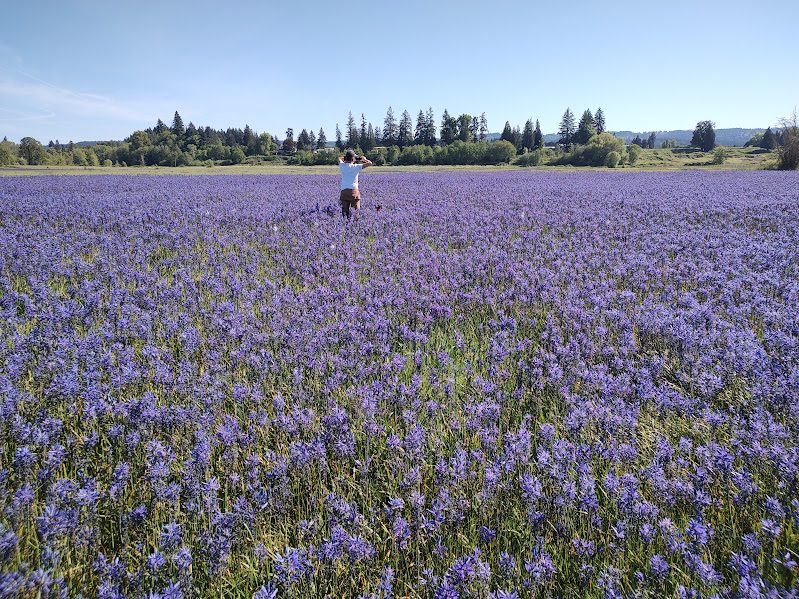
Hundreds of thousands of acres of wildflowers were ours to do with as we would and now, there is almost nothing left of it. It’s just dumb luck that there is anything left at all. What exactly does this say about us? Let’s be honest about that.
The good news, as always, is that there is a better way forward. We can have scenes like this, not just in a few scattered parks, but throughout the Willamette Valley. The above scene is not in a park, but rather in an active farm and ranch property in Washington County that we are managing for various farm products, including beef and berries. Wild plants like the camas above can be incorporated into multiple crop systems, including hay, pasture, Christmas trees, filberts, berries, orchards and others. In these settings, wildflowers can support pollinators and other flying insects, birds and an entire web of organisms to create interconnected ecosystems, while at the same time producing plenty of healthy food for humans. This is absolutely possible, but only if we get serious and start looking honestly at what we are telling each other and teaching the next generation.
For instance, Christmas tree culture in the Willamette Valley is a big business, with over 40,000 acres in production today. The vast majority of this acreage is intensively managed with herbicides and fungicides. Most Christmas tree farms employ an arsenal of pre- and post-emergence weed killers to maintain a “scorched earth” condition. That’s a lot of chemical and a lot of ecologically dead ground. Here is a list of the most common herbicides promoted by Oregon State University Extension. OSU knows and states on their extension materials that many of these products pose a threat to groundwater, or have other known significant environmental concerns. Beyond the stated negative effects, many other known hazards exist with these chemicals..OSU promotes them anyway:
Dichlobenil (Casoron) – Groundwater hazard
Indaziflam (Marengo – Extremely persistent
Oryzalin (Surflan A.S.) – Toxic to fish
Pendimethalin (Pendulum 3.3 EC) – Toxic to fish
Pronamide (Kerb 50W) – Probable human carcinogen, highly toxic to fish
Simazine – Groundwater hazard
Atrazine – Endocrine disruptor, groundwater hazard
Metribuzin + flufenacet (Axiom DF) – Groundwater hazard
Flazasulfuron (Mission) – Highly persistent and highly toxic to fish
Flumioxazin (SureGuard) – Toxic to aquatic invertebrates
Hexazinone (Velpar DF) – Groundwater hazard
Hexazinone + sulfometuron (Westar DG) – Groundwater hazard and long soil residual
Oxyfluorfen (Goal 2XL) – Possible human carcinogen, toxic to aquatic invertebrates, multiple highly persistent fluorinated breakdown products.
2,4-D – (GK note – the better half of Agent Orange)
Asulam (Asulox)
Clopyralid (Stinger) – Groundwater hazard
Flazasulfuron (Mission)
Fluazifop (Fusilade DX)
Glufosinate (Finale) – Groundwater hazard
Glyphosate
Sethoxydim (Segment)
Triclopyr (Garlon 3A, Vastlan) – Groundwater hazard.
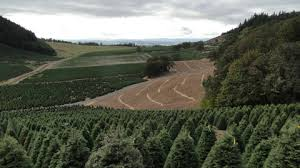
Is it any wonder that we have lost most of our bees in the Willamette Valley and that our fisheries remain endangered? What more do we need to know? The Christmas tree you buy at a lot or cut from one of these farms is contaminated with many of the above herbicides, and worse, with a cornucopia of fungicides that pose multiple threats to humans, especially children. And here is the kind of landscape generated with the use of the above herbicides and actively promoted by our own Extension Service – landscapes devoid of plant diversity and pollinator habitat, and bleeding pesticides into streams and groundwater:
And here is what is possible, with just a little consideration for natural systems:
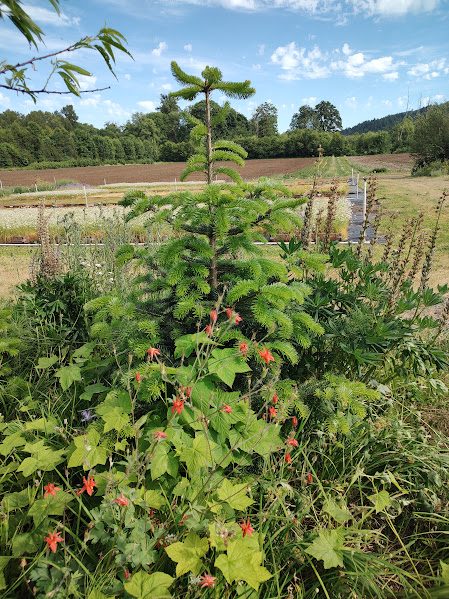
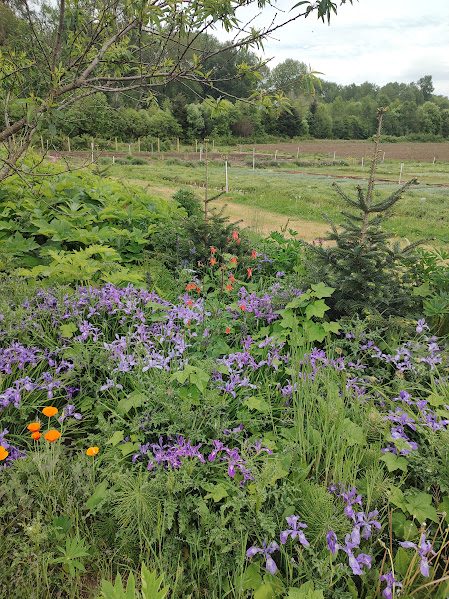
Our Christmas trees are absolutely beautiful, without herbicides, fungicides or any pesticides at all. And we have bees. And we don’t harm fish. And we aren’t polluting groundwater for the rest of time.
What are you going to choose? Hopefully you’ll choose the wildflowers! And we have plenty of them to choose from. Right now, we are offering the following bare-root woodland and prairie wildflowers on sale:

All of these are 30-50% off our regular prices! Just call or send us an email and mention this blog. Now until Friday March 20 only, per-species minimums and our $300 total order minimums apply. Please order in increments of 50.
Thanks for reading!
-George