
I am a big fan of good data, basic math, and logic. There is so much we can understand about where we are, where we have come from and where we might go with these three simple ingredients. Here is an example:
AREA OF HABITABLE VEGETATED LAND ON EARTH: 25.6 billion acres
HUMAN POPULATION 2025: 8.33 billion people
ACRES OF VEGETATED LAND PER PERSON: ~3 acres
Wow, just that bit of analysis tells us so much. Each of our little patches of land is a square, 360 feet on a side. You could traverse your little patch of ground in less than a minute and a half at a leisurely walking pace. On this little square, most of your basic needs are supported – fresh water, clean air, food, wood for your houses and paper for your bathrooms, minerals to provision you with cars and gadgets, etc etc. It’s a lot to squeeze into a tiny square, much of which is pretty marginal ground. Most of your patch of land is tundra, taiga, steep, rocky mountains or dry, windy steppe. Most of it won’t grow a good tomato.
Now let’s consider how that bit of information interstects with the following graph, presented a few posts back:
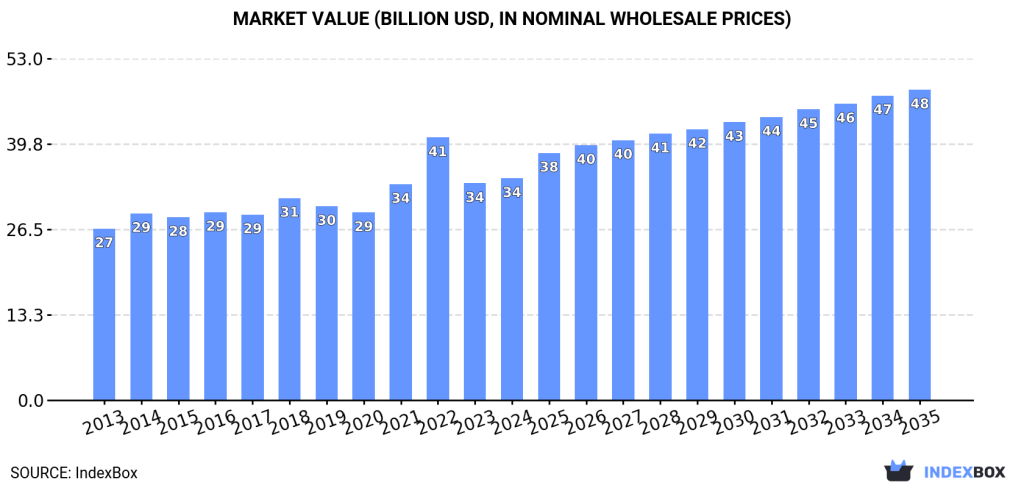
The global wholesale herbicide market!
Global sales of herbicides totaled 5.28 billion pounds of active herbicide ingredients in 2025, earning a whopping $38 billion dollars for Big Chem. That’s 0.75 pounds of pure plant killer for every person on Earth, enough to kill all of the vegetation on one of your three acres every single year. By 2035, Big Chem hopes to be selling almost 9 billion pounds of plant killer per year. This will be more than sufficient to spray over half of your little square every year. And somehow, some of us seem to expect that not only will the planet continue to provide us with clean air and water, we will also have bees, birds, elephants and other wildlife. I guess I’d have to ask, where? And how?
Oh yeah, and don’t forget the trash. Global plastic consumption in 2025 was 1.14 trillion pounds. So somewhere on your little square, you need to find a place to bury 136 pounds of plastic trash every single year. If you’re lucky enough to have a river flowing through your square, you could just chuck it in there like most of the “developing” world does. Or you could try burning it, but the neighbors might be unhappy about that. Of course, Americans discard more than twice that much annually, but hey, it’s share and share alike on our little planet. What’s mine is yours, right? And Big Chem has to live up to Wall Street expectations, otherwise how are y’all going to retire in style? Wall Street is really motivated to pump up your 401K, so by 2035, Big Chem is planning that you will need to make room for 185 pounds of plastic trash every year. So, figuring a more or less linear increase in your annual trash pile, that’s 1600 pounds of stinking plastic garbage piled up on a corner of your little square, and leaching phthalates, plasticizers, dyes and thousands of other chemicals into your groundwater just in the next ten years. I hope you have a state-of-the-art water purifier..
And a final by-the-way, you are going to have to carve off 8700 square feet of your little square for the newcomers in 2035. They gotta live somewhere. Maybe you can carve off your trash heap and let them have that.
So you see, we don’t have a lot of room to spare, and how we manage our little squares really matters. It’s hard to believe that we can get so much from such a small area. It’s impossible to believe, unless you are insane, that we can keep doing what we are doing for much longer.
Back to the herbicides, the Silent Spring of the 2020’s, it has to stop. We are using these chemicals at an ever increasing pace to make our monocultures of corn, Doug-fir and oil palms grow faster, but we are wiping out plant diversity at a gargantuan scale. The landscape is still green, but it’s dead. There are no insects, there are no birds. Go out to your local corn or fescue field and walk out in the middle. Do you see anything else alive? Maybe a few ear worms and crows. The fescue fields are eerie. You will find some meadow voles, but you gotta wonder what it’s like for a vole to have nothing to eat for an entire lifetime besides fescue. Most of the Willamette Valley is in this condition. It’s green, but it’s dead. And we are now doing the same thing to the Coast Range.
Please notice and care enough to call ODF and ask them to stop.
ODF Forest Grove (503) 357-2191
ODF Tillamook (503) 842-2545
https://www.oregon.gov/odf/board/pages/commentsboard.aspx
-George